On Friday night at the Polish National Opera, the curtain went up on the first performance of Mothers of Kherson. It revealed a concrete bunker, mothers and children in anxious huddles, of a sufficiently piercing naturalism as to cast a thin-lipped rebuke at the overuse of the setting in modern stagings of canon operas.

A short prelude of pounding dissonances, like Zimmermann’s Die Soldaten as edited by Prokofiev, had already set the scene for a war opera of families falling apart against the backdrop of conflict, in the lineage of Verdi from Nabucco to Don Carlo. But no: what unfolds over the next two and a half hours is a rescue opera, in an equally distinguished tradition dating back to Beethoven’s Fidelio and Mozart’s Die Entführung.
The story is a true one. Russian troops retreated from their occupation of Kherson in November 2022, having already abducted thousands of children, both from orphanages and from families who had been assured that they were being offered temporary sanctuary at “Camp Sunshine” in Crimea. As the months passed, far from being returned, the children were instead being rehomed in Russia. In April 2023, Reuters reported how a group of Ukrainian mothers had travelled via Poland, Belarus and Moscow to rescue their children.


The slow turning-circle of opera – writing and then making it – does not usually afford so rapid a response to its subject. In this case, the Metropolitan Opera commissioned composer Maxim Kolomiiets and librettist George Brant later that same month, its director Peter Gelb having determined soon after the full-scale invasion to commission a new Ukrainian opera. As founder-conductor of the Ukrainian Freedom Orchestra, his wife Keri-Lynn Wilson has already led excerpts from the opera in concert, and recorded an orchestral suite for DG.
Born in Kyiv in 1981, Kolomiiets has the credentials of a Ukrainian modernist with past premieres at Darmstadt and Donaueschingen. In 2015, Brant made his one-woman play Grounded into a full-scale opera for the Met (composed by Jeanette Tesori). In Mothers of Kherson, their partnership unpredictably sparks and splutters to life, like the coach that eventually gets the women to Crimea.
“Given my body of work to date,” Kolomiiets has remarked, “it would be hard to imagine that a score sounding like this would actually come from me.” Ukrainian folksongs ground its tonal identity, both sung and skilfully woven into the orchestral texture. Outside several touching arias for the three central heroines – Mothers of Kherson aces the Bechdel Test of female representation – the music tends to sit on a rolling boil of overwrought pathos, which strikes some false chords with the libretto’s own uneasy hybrid of contemporary demotic, conscientious exposition and high-flown lyric sentiment. Vocal writing is often stronger in the cutaway scenes for Russian villains, such as a magnificently wicked Baba-the-Turk interlude for the real-life Minister for Children’s Affairs, Maria Lvova Belova, as she boasts of her best maternal intentions to the cameras while surrounded by cowed Ukrainian children.

“All this because I just wanted you to hate me a little less.” So the central protagonist Kateryna sings to her faraway daughter. Such lines leave a deep mark, probably a lasting memory too, along with the rattling minimalism and hauntingly hollowed-out expressionism of the orchestral interludes where Kolomiiets’ score really takes flight. Where composer and librettist join forces most powerfully is in the choruses, none finer than a baleful, Khovanschina-style declaration of solidarity early in the piece.


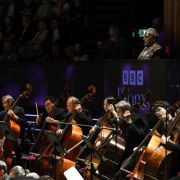
In the event, however, Barbara Wysocka’s staging works small miracles in mediating and bridging these aesthetic tensions, which are further resolved by the conviction and authority of the actual performance. Wilson holds the intricate orchestration in a firm grip, with the singers never drowned by remarkably taut playing from the Orchestra of Polish National Opera. An outstanding cast is led by the tireless Kateryna of Izabela Matuła, her tone vibrantly projected yet fully centred even in fierce protest and declamation. The more pliant soprano of Kamila Dutkowska makes a happy contrast as Dasha, while Małgorzata Walewska captures both the subversive wit and the failing health of grandmother Olha. Least vestigial among the male supporting parts is the unnamed bus driver, and Ólafur Sigurðarson bestowed on his requiem for Olha a down-to-earth dignity that fully rose to the occasion as the opera’s point of repose.

It’s probably best not to think too hard about the rousing defiance of the opera’s final chorus, and instead attribute to it a dramatic and political necessity, of light conjured by pure hope from the darkness, in the mould of Shostakovich's triumphant finale to his Leningrad Symphony. While the lights go out all over Kyiv, with many thousands of Kherson’s children still captive in Russia, the flame of that hope looks dimmer than ever. By the time that Met audiences hear the opera for themselves in April 2028, it remains to be seen whether hope and art will have translated into action.
Peter’s press trip to Warsaw was funded by Polish National Opera