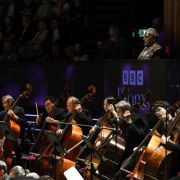
“I like things I trust.” We often hear musicians talk of placing trust in their colleagues, or their institutions, but the concept takes on a new dimension when applied to the music itself. Edward Gardner is talking to me about the music of Kristine Tjøgersen, and specifically her piece Between Trees, which opened his BBC Prom in July with the London Philharmonic Orchestra. For the greater part of the work’s 12-minute duration, the players evoke the spiritual space as well as the acoustic sounds between those trees with unpitched taps and rustles and chirps. “The players are being asked to play unnaturally for the entire piece,” says Gardner, “but everyone comes around because they trust how good it is.”

“One of the most thoughtful and well-conceived of this year’s Proms,” remarked Dominic Lowe in Bachtrack, of a nature-themed programme which moved from Tjøgersen’s Nordic forests to the folkloric Eden of Joseph Canteloube’s Songs of the Auvergne, and then the Nietzschean conquest of Strauss’s Alpine Symphony. A comparably thoughtful spirit of adventure pervades Gardner’s concerts for the coming season with the LPO. “I'm not someone who ascribes to any kind of eras with a capital letter. I like things I trust, and the fact that Tjøgersen worked out every single element of what every single player has to do makes her music incredibly trustworthy, and I love the effect of standing in front of it. I think that’s an opera conductor thing, isn't it? We conduct such a variety of music and eras from the very beginning.”
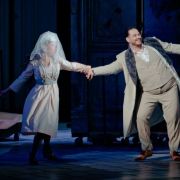
It strikes me that Gardner’s operatic background (formerly music director at English National Opera, now at the Norwegian National Opera and Ballet) is becoming increasingly rare, and precious. Working your way up the rungs in an opera house used to be regarded as the hard way but also the only way for a conductor to succeed. “In the age of Karajan and Solti,” he acknowledges, “it was sort of biblical that this was the way you had to do it. In an opera house, you get faced with a kaleidoscope of challenges so early on, and that helps your development a lot. But it’s definitely not the only way to do it. People who come from operatic backgrounds often have insecurities about not having conducted a Beethoven cycle by the age of 35. Simon Rattle said you have to conduct your first Schubert ‘Great’ C major Symphony when you’re 25 because you’re going to be terrible at it for 30 years. I love that.”


Gardner continues: “We all have areas of expertise, and we all have blind spots. The experience I reference is conducting 20 Bohèmes with Glyndebourne Touring Opera in my late 20s. Learning to do things better every night was probably my greatest educative experience.” Gardner brought that experience to bear on the LPO from the beginning of his tenure in September 2021, with a concert (and live recording) of Tippett’s first opera The Midsummer Marriage: “simply incandescent,” wrote Matthew Rye. Their Tippettian adventures together since then have included A Child of our Time, the Piano Concerto (with Steven Osborne) and the Second Symphony, “which is as rhythmically obtuse as it gets, like patting your head and rubbing your tummy at the same time, even for a great orchestra. But the meaning behind the music and the Beethovenian drive of that piece was so intoxicating to all of us in the room that we got past the difficulties very quickly.”
Gardner is now, for the first time, facing up to the challenge of the Fourth Symphony, and ingeniously prefacing its birth-to-death narrative with a Sibelian death-scene in The Swan of Tuonela. “There’s a connection between the end of the Swan – that luminous final chord – and the opening of the Tippett, which I discovered listening to them side by side. I don’t know whether I’m brave enough to go directly from one piece to the other, but I love the idea of doing so.”
This LPO programme, on 24th February, opens with the Concerto for Orchestra by the orchestra’s Composer-in-Residence, Sir George Benjamin. “It’s concise, virtuosic, immediate,” says Gardner, “and scored for a chamber group that’s smaller than some of his big pieces like Ringed by the Flat Horizon. There's something of his operatic language in it: a distilled melodic voice that he seems to generate at will in a way that Ravel did.”
An unmissable, one-off opportunity to taste the fruit of Benjamin’s latter-day self-reinvention as an operatic composer arises on 25th November, when Gardner leads a LPO semi-staged performance of Lessons in Love and Violence. Benjamin himself conducted the opera’s premiere at the Royal Opera in 2018, and Gardner felt some trepidation when taking on this fastidiously exacting music, as well as excitement. “But he’s been so generous and kind. And I adore his voice.”
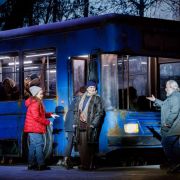
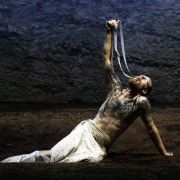
Another British composer running through Gardner’s season is Benjamin Britten. He takes the composer’s final opera, Death in Venice, to Munich in July 2027, for a run of performances with the Bavarian State Opera. More immediately, he opens the LPO’s season on 26th September with the War Requiem. “I’ve conducted a lot of Britten, and I’m right in the midst of re-finding my love for it.”
Having conducted the War Requiem once at St Paul’s Cathedral, Gardner put the piece to bed, as it were. “Coming back to it, I love it a lot a lot more deeply than I did the first time.” He has been thinking about the World War I poetry which inspired Britten. “This was the war where our country lost its innocence. We’re too far away from it to know for sure, but I feel a connection through the poetry that’s incredibly grounding for the piece in a strange way. And I’m still surprised by his bravery in the way that he shifts cinematically between these big Latin gestures into the chamber world of the Wilfred Owen settings, and I think that’s what’s so effective for an audience.”


At least as much as the opera pit, these big choral-orchestral works find Gardner in his element. In the choral scenes of Peter Grimes, Boris Godunov and Benvenuto Cellini at ENO, and latterly in LPO performances of the German Requiem, Mahler’s Eighth and The Dream of Gerontius, his skill and delight in working with choirs has been palpable. “It’s my upbringing,” he replies, “even more than opera. Those are the pieces that I feel I've been doing since was a kid. Singing in choirs and then chorus mastering: that was my upbringing, and I love it. I think it’s central to the work of the LPO, and – to be evangelical about it – I think they’re the pieces which really speak to our audiences. On top of that, they’re the pieces which make the Royal Festival Hall sing. It’s not the easiest hall in the world – it’s not the worst, either! – but those pieces create a kind of event in that room.”

With the London Philharmonic Choir celebrating its 80th anniversary in the coming season, there will be opportunities galore to hear it in full flight. Under Gardner’s baton alone, they are singing Fauré’s Requiem and the Dona nobis pacem by Vaughan Williams (27th February), Elgar’s Gerontius once more (24th April), and a treasurable revival for Schumann’s Paradise and the Peri (10th April). Gardner credits Rattle for introducing him to this haunting score, which Schumann himself regarded as his finest work.
In the UK, Britten was a pioneering champion of Schumann’s later Scenes from Faust, and a feeling for poetry connects the two composers, and perhaps Gardner’s affection for them too. In the Peri, he finds “an undertow of a feeling that words cannot express – much more so than in, say, Brahms. This transcendental yet human quality that Schumann seems to have deeply embedded in himself is the centre point of our world. I don’t think most of us have enough Schumann in our lives!” The challenge for the conductor, across the oratorio’s three parts and the Peri’s search for redemption, is to make it all hang together. “But in the study I’ve already done, the communicative effect of what that piece does to you is extraordinary. You need to trust that from the beginning.” Rich musical rewards await LPO audiences who place their trust in Gardner over the coming season.
Edward Gardner conducts Britten’s War Requiem with the LPO on 26th September at the Royal Festival Hall.
See upcoming performances by the London Philharmonic Orchestra.
See upcoming performances by Edward Gardner.
This article was sponsored by the London Philharmonic Orchestra.