Amanda Britton, Principal and Artistic Director of Rambert School, is quietly pleased at how events have progressed this year. When we speak, the school is just a couple of weeks away from performing a new work by Sir Wayne McGregor at Sadler’s Wells East, a collaboration with The Juilliard School in New York and the first of its kind. She can hardly believe that it’s all coming to fruition.

Britton goes back to the beginning to explain to me just how exciting it’s been. “I was in New York, holding auditions for Rambert School and I was going to meet the then principal of the Dance Division at Juilliard, Alicia Graf Mack. She was considering some more collaborations with her fourth year students, and I jumped in and said we’d love to collaborate with you! I’d always been a big admirer of The Juilliard School.” She continues, “The standard is incredibly high, though actually the dancers are a little older than ours. I thought it would be great if we could ask somebody to make work on both schools, and see if we could do some sort of student and creative exchange around that.”

“I approached Wayne McGregor.” She sounds almost surprised. The school had just performed one of his works the year before, which had gone really well. “He took two dancers from the school into his company, so he was quite keen. He told me that he had been collaborating with Google Arts and Culture on a book he’d written. They’ve developed a machine learning collaboration called AISOMA. He agreed that it would be interesting for him to be working with younger people. I mean, they’ve grown up as digital natives as it were.”


Britton went ahead and set up the exchange. “Our students went there, and their students are coming here to complete the last bit of the project. The creative part in the studio so far has been very much like Wayne’s normal process. Wayne himself hasn’t worked with them yet. They’ve worked with Odette Hughes, who’s been Wayne’s right hand person for a long time. And Louis McMiller, former dancer and now re-stager. Juilliard has worked with Studio Wayne McGregor Company Artist Jessica Wright.”

Britton admits that she was worried I was going to ask her to explain the technology lying behind the piece, but gives it a try anyway! “I don’t know exactly how Wayne is going to bring it all together,” she says, “but I believe it’s the choreographic tool he’s developed with Google Arts which feeds off hours of footage from Studio Wayne McGregor’s archive. It’s an AI tool. He’s uploaded all of his archive choreography in order to generate original choreography from the archive.” Both groups of dancers have already come together, Britton adds. “They’ve shared their processes, they made some new material which they did in New York in March, and when they come together next week I’m assuming there will be another mixing, another regeneration of more movement material. There’s a lot still to happen. He was setting tasks here and the same in New York in order to create the piece of choreography.”
I’m curious to know how the two schools will look together. Britton explains, “On paper, the curriculum looks the same: ballet, modern dance – critically because not that many dance conservatoires in the UK teach modern dance technique (Graham and Cunningham), Horton, Limón, Gaga, improvisation and creative. Juilliard students also have a four year programme. I would love the luxury of a four year programme. Having another year would consolidate professional skills. But the model in the UK does not allow for that, mainly because of funding.”

On the Sadler’s Wells website, it says that McGregor is the choreographer. “But is it his choreography?” I ask. Britton reflects, “There’s the golden question! Wayne and many other choreographers now, make work by setting tasks which generate movement material from the dancers themselves. He’s always made his work that way. Siobhan Davies also did it when I worked with her years ago.The choreographer’s vision is more around curating, editing, pulling out, putting together, rejigging.”
This prompts me to think that the way forward with choreography is completely collaborative, though I’m sure there are plenty of choreographers out there who would disagree. “When I joined Rambert in 1984,” Britton says, “everything was always already created. You were just a body in the space and you just did what you were told. Over the intervening years I think most choreographers work collaboratively. It gives a richness to the work and a personal investment in a way that develops the work specifically for the dancers, around their skills.”


Inevitably, I wonder if this way of working is actually a way of promoting a whole new generation of choreographers as well as dancers. She laughs, “That’s a great question! I’m not going to speak for any choreographers, but I think it’s more the expectation today that dancers will be able to do it. One has to embed those things like improvisation in the training. These days, if you go to a Rambert or Nederlands Dans Theater audition, only a small part of the audition will be about dance technique. You’ll learn some rep, do some improvisation, have an interview – it takes two days. Thousands of people went for Batsheva last year and one of my dancers got the job!”
This all sounds very daunting, and slightly off-putting. She continues, “The first stage is all online, you have to film yourself. If you get to the next stage, you have to get on a plane to wherever and there will still be many people in the studio. It’s very, very competitive. When we first started Rambert2 in 2020, we had 800 people turn up at the audition! There are not enough jobs and Brexit has made things considerably worse.”
The project culminates in performances next month of Augmented: Dance powered by MAM + AISOMA. Britton raves about the experience. “This project has been unbelievably inspiring for our dancers. To meet the Juilliard dancers who are a little bit more mature in their thinking. They bonded almost immediately. It was really quite moving to see. We’ve become a big family.”

I can’t begin to imagine how they have made it all happen. She explains they’ve had to do a great deal of fundraising and it is a very expensive exercise. She tells me, “We have a number of ongoing projects. I’ve got another group of dancers who went to École des Sables in Senegal. That was really a cultural mind opening experience for them all. We’ve had some donations from our friends and supporters. We haven’t quite achieved our target yet. It is costly, these are high profile choreographers; there’s travel, accommodation but I have the support of our board. I’m just hoping to raise the profile of the school.”
She’s mulling over how the piece will eventually turn out. “We have 33 dancers and it has to be danced within an hour. The music has already changed. From a selection of random pieces, we know we are going to have a live DJ, which is really exciting. The bits that I’ve seen – the standard of the dancing is so high, they just don’t look like students.”
Britton finally confides in me. “When everyone said yes to the project, I did do a little ‘happy’ dance! Since Covid, I think people do want to collaborate and make things happen. If you have a lot of determination, you can do these things. There’s a lot in that because it is hard. As ex-dancers we have had years of being criticised and building resilience. In this second chapter of my career I find I’m even more determined.”
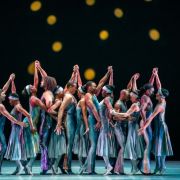
Dancers from the Rambert and Juilliard Schools perform Wayne McGregor’s Augmented at Sadler’s Wells East on 1st & 2nd May.