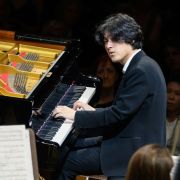
It’s common practice for soloists to leave after their performance, which usually concludes the first half of a concert. They’re done and gone. Uzbek pianist Behzod Abduraimov likes to hang around, especially for Czech Philharmonic concerts at the Rudolfinum in Prague. “Why not?” he says. “It’s an opportunity to hear a world-class orchestra in a beautiful concert hall. I am always amazed.”

The same might be said of audiences who come to hear Abduraimov play with the orchestra. In 17 concerts over the past 12 years, he’s forged a rare bond on and off the stage, captivating listeners with dazzling performances of difficult pieces by Tchaikovsky, Prokofiev and Rachmaninov, and developing collaborative relationships with a series of conductors.
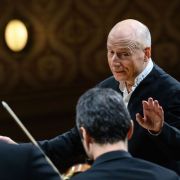
Those relationships encompass the Czech Philharmonic’s past, present and future. They include Jiří Bělohlávek, the guiding light of the orchestra until his death in 2017; Jakub Hrůša, who will take over as chief conductor starting in the 2028–29 season; and the current chief conductor and music director, Semyon Bychkov. Abduraimov will reunite with Bychkov next month for three performances of Rachmaninov’s Piano Concerto no. 3 in Prague, followed by a brief tour through Antwerp, Paris, Barcelona and Madrid.
“It’s quite unique,” Abduraimov says of his relationship with the orchestra. “It’s pure music-making without any affectation, especially with such great conductors, very enjoyable.”

Abduraimov has an even longer history with the Rachmaninov concerto, which he recalls first hearing at the age of six. His mother would play classical records at home, and the Rachmaninov concertos, with their elaborate orchestration and complex solos, cast a spell. “I was fascinated by all the sound that came out,” he says. “It was like a different world. I wanted to be part of it one day.”


By then, Abduraimov had already started formal piano lessons with Tamara Popovich at Uspensky State Central Lyceum in Tashkent. When he was 14, she told him it was time to learn Rachmaninov’s Third. “For the first time, I refused,” he says. “Not that I couldn’t play it, technically I was capable. But musically, it was difficult to comprehend at that age. I just wasn’t ready.”
Ten years passed before Abduraimov decided to take it on, and not under the best of circumstances. He was touring in Australia, essentially learning the piece on the road. “I was nervous because I didn’t have that much time to prepare,” he says. “I think in total I had about five weeks to learn it, which is not that much time. The technical side of the music is not easy, you have to work, you have to prepare every time you play it. But that’s not the point. It’s being in the service of the music, and bringing all those big emotions to life.”
Still, the reviews for those first performances were good. And in retrospect, Abduraimov is glad he waited. “When you’re an adult, you look at the music differently,” he says. “That was the right time.”

The concerto is considered notoriously difficult, demanding virtuoso technical skills, deep emotional expression and both physical and mental stamina. Polish pianist Josef Hoffman, to whom Rachmaninov dedicated the piece, declined to take it on. (Instead, the composer himself gave the premiere in New York in 1909.) But it has become a pivotal piece in Abduraimov’s repertoire. He made his debut at the BBC Proms with it in 2016, and performed it later that year for the first time with the Czech Philharmonic, under Bělohlávekʼs baton. In 2017 he made a live recording of the concerto with Valery Gergiev and the Royal Concertgebouw Orchestra that was nominated for an ECHO Klassik award when it was released in 2020.
“Now it’s one of my favourite concertos,” he says. “I think it’s one of the pinnacles of Rachmaninov’s creativity.”
Which is not to say that it’s gotten any easier. Abduraimov prefers to call it a “concerto symphony” because of the structure, which treats the orchestra and the soloist as equal partners. “There’s a lot of fortissimo markings for the soloist, but the orchestra also has a lot of fortissimo markings, so in a sense you’re competing with them,” he says. “You have to work on that. It’s obvious that the orchestra is not just providing accompaniment.”
While trying to keep up with the orchestra, the soloist also has to provide uncommon emotional depth. “There are a lot of intimate places, but there are also a lot of huge moments,” Abduraimov says. “So you have to show the individuality and the drama and the nostalgia and this huge diversity of emotions. That’s the challenge of it. It calls for great sensitivity.”
And at least for this pianist, it should be different every time out. “Your understanding of the music grows as you play it,” he says. “So even if you wanted it to, I don’t think it’s possible for the piece to sound the same. If you’re growing as an artist and performer, it should sound different.”


Audiences will have a chance to hear the differences when Abduraimov returns to Prague next month to play the concerto with Bychkov and the Czech Philharmonic. His last appearance with the orchestra was in 2022, playing Rachmaninov’s Rhapsody on a Theme of Paganini, an experience he found enlightening.
“Maestro Bychkov sat down with me and we went through the piece bar by bar,” he says. “He was very specific, giving me suggestions that I was happy to get. It was very educational. Not just going through the score, but in seeing how he worked with the orchestra. He takes everything very seriously, paying close attention to every detail. It was really instructive.”

Then there is the orchestra itself. Abduraimov has played with some of the world’s best, and he puts the Czech Philharmonic in the top ranks. “It has a long history and a very distinctive musical identity,” he says. “You immediately sense this history, especially in the warmth of the strings and the individuality in their principal woodwinds. For me, it’s always a special occasion to perform with the Czech Philharmonic. It’s a big honor.”
As someone who has played in every conceivable type of setting, he also appreciates the orchestra’s home hall. “The sound at the Rudolfinum is very clear, you can hear everything,” he says. “You can go quite extreme with dynamics. One could say that it sometimes feels overwhelming, but that hasn’t been my experience. I think it allows you to push the music without too much compromise.”
Playing Rach 3 there and on tour with the orchestra will be one of the highlights of the 2026–27 season for Abduraimov, who normally maintains a busy schedule. He was out doing recitals before the season had even begun. But after the tour, he’s built more breaks than usual between performances. “I want to give myself time to learn more repertoire and be prepared emotionally,” he says. “Because I take every concert as a big emotional journey. And you need a little time to prepare for that.”
Meanwhile, he’s looking forward to reuniting with Bychkov and the orchestra. “The last time I was there, after all the preparation we did I felt very comfortable when I got onstage, able to relax and be in the moment and just let it go,” he says. “I’m hoping for the same results next month.”
Behzod Abduraimov performs Rachmaninov’s Third Piano Concerto with Semyon Bychkov and the Czech Philharmonic on 21st–23rd October at the Rudolfinum, Prague, and on tour from 6th November.
See upcoming performances by the Czech Philharmonic.
This article was sponsored by the Czech Philharmonic.