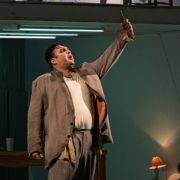
An unidentified man walks onstage, wanders around a sparsely furnished living room and, when the music finally starts, sings “I will never get out of this forest.” It’s a disconcerting opening to the National Theatre’s new production of Pelléas et Mélisande, and deliberately so. Like the other characters in director Christof Loy’s rendering of Debussy’s only opera, Golaud is more of a walking metaphor than a real person. And the disconnect between the set and libretto is only the first of many that keep the piece untethered from reality. For viewers expecting a passionate portrayal of a love triangle, it’s a long evening.

The charitable view of Loy’s approach is that it accurately reflects the source material, Maurice Maeterlinck’s eponymous 1893 play. Symbolism was all the rage at the time, prompting the playwright to recast a classic tale of love and betrayal into an allegory of existential despair. Plot, character, even rationality take a back seat to a depiction of merciless fate closing in on bewildered, hapless humans for whom death offers the only escape. The mood is ominous, the situations surreal, logic a false construct – all these elements Loy captures effectively.


How they play out for 21st-century sensibilities is another matter. Despite contemporary costumes and sets, there’s no one and nothing to relate to onstage, just misguided figures blind to their circumstances, fumbling their way to their doom. Maeterlinck wanted to supplant traditional acting with what he called “static theater”, which is a good way to describe the movement (or lack thereof) in Loy’s treatment. Coupled with the spare sets, his minimalist approach gives this version of Pelléas a sterile feel, an impression reinforced by deliberately wooden acting. And while incongruities in updated productions are not uncommon, the nonstop absurdity of these – “Where’s my sword?” Golaud asks while looking for his rifle – borders on comic distraction, almost daring viewers to keep a grip on credibility.

Loy has a knack for creating powerful visual moments. Physically framing Mélisande between Golaud and Pelléas in the first act telegraphs the brothers’ competing affections, and Pelléas and Mélisande embracing in the second act with supine bodies in the background offers a powerful juxtaposition of love and death. But more often the staging is leaden, or just confusing. Loy likes to keep his characters onstage, so Golaud is in the room while a letter is read to his grandfather Arkel saying that he’s at sea. Slo-mo movements deaden a piece already singularly lacking in action. And there are long musical interludes where absolutely nothing happens.

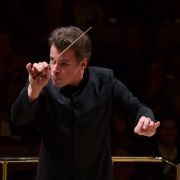
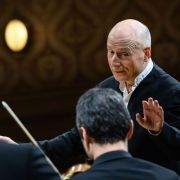
On the plus side, less happening onstage means more opportunity to focus on the music, which is sublime. In insightful program notes, visiting conductor Patrick Fournillier describes the role of the orchestra as neither accompanist nor commentator, but rather an independent voice, which he brought to life eloquently. The music set mood and tone, extended vocal lines, offered occasional counterpoint, built tension – and most importantly, revealed characters’ inner thoughts and feelings. Fournillier also made the most of the occasional pauses in the score, letting them serve as silent statements. Working well outside of its usual repertoire, the National Theatre Orchestra did a superb job playing softly yet with colorful conviction under his baton.


Arnheiður Eiríksdóttir was in good voice as Mélisande, tender and vulnerable. She is also an accomplished actress who unfortunately was limited to nothing but cowering in this role. David Oller (Pelléas) and Pavol Kubáň (Golaud) both turned in strong singing performances, though neither showed much in their limited acting opportunities, other than Kubáň’s exasperated rage over his wife and half-brother’s trysts. Anders Lorentzson made a serviceable Arkel, and young Joshua Alvarez won the audience’s heart as Yniold, the beleaguered son of jealous Golaud.
On balance, there is certainly something to be said for preserving the original form of a work like Pelléas et Mélisande, bringing a historical dimension to the performance. But asking a modern audience to sit through a nearly four-hour production that doesn’t offer any real drama until the final act is a stretch. Symbols are a language of their own that apparently doesn’t always resonate across eras. Or at the very least, needs some translation.