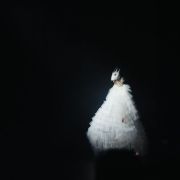
On the day Okwui Okpokwasili and her collaborators sweat variant, premiered adaku, part 2: she shivers with it at the Brooklyn Academy of Music, the share price of Nvidia, the world’s top chipmaker, had fallen almost 30% from its high of a year prior, wiping out over $1.5 trillion in shareholder wealth. As shudders ran through the global economy, a few hundred of us sat in the near-dark at BAM, enveloped in the sounds of a Wailing Chorus that evoked the ancestral horrors on which much of Western wealth was built.

Four performers huddled on the floor of a spare white set designed by Peter Born, Okpokwasili’s husband, who is also credited with direction. They struggled to keep their balance and comfort each other while footage of turbulent ocean waves played across the ceiling above them. The pre-recorded wail – augmented by the individually miked performers – seemed to emanate from all points in the house, a soundtrack of terror reverberating throughout as we sat in three-quarter-round. Beautiful and chilling, it held us long enough to feel the unbroken current connecting the Middle Passage to the modern markets quaking outside.


The wail began at the end of part 1 of the adaku trilogy of performance pieces, which I missed when it premiered in 2023. Subtitled the road opens, it chronicled the mysterious goings-on in an unnamed West African community who lose a daughter to the slave trade in pre-colonial times.

In part 2, a quartet of Okpokwasili, Bria Bacon, audrey elaine hailes and AJ Wilmore emerged from the far side of the wail to tell us a story. They read in unison from scripts in their hands, with the same intonations and the same precise choreography. They even discarded pages of the script in unison, which fluttered to the floor like seabirds skimming whitecaps. While they remained deeply attuned to each other, their faces and postures registered varying degrees of astonishment, weariness, indignation and amusement.

Suddenly we had skipped over several centuries and an ocean to present-day America. A tale of a mother who showed up at her own funeral unspooled in a whimsical looping fashion that dissolved time and distance. The writing was tight and witty, a kind of quotidian poetry, the imagery devastating. One passage described how other bodies enter the body of a woman who contains multitudes: through a slit in the iliotibial (IT) band along the side of the thigh – an image now wired into my synapses forever. So is the mother’s origin story: born on a New York City sidewalk where her own pregnant mother went into labor, “brown on a street in Midtown.” The newborn “shot out of her vagina like a projectile” into the hands of a stunned Wall Street type, who “caught it in a memory of his football days, in the end zone of the placenta.”


Those indelible moments marked the life of a woman “born in flight… forever a runaway,” who “could not keep her disorder to herself” – unlike the other women in her family, who had the capacity to bottle up their rage.

The long virtuosic reading by this collective griot, filling out the tale of a clan beset by disappearances through the centuries, was as mesmerizing as the wail. It was punctuated by sighs and the recurring question “you follow, you follow?” and backed by the sounds of guitar, sax and claves in gently ironic counterpoint.
The storytelling segued into a wordless ritual of trust. Each of the performers crumpled in turn but never hit the deck, braced by the others. Closely entwined, the four continuously recomposed themselves, one hand cradling a head, others under a hip, a thigh, a knee. They made a kind of living sculpture.
These gripping elements – the wail, the storytelling, and the tangle of bodies – felt loosely cobbled together, with some loss of tautness and imagination in the transitions. Yet Okpokwasili possesses an uncanny ability to summon the past and weave it into the present, in an art both intimate and epic in scale.