There’s a heartening sight you rarely see when a renowned dance company is installed at Lincoln Center: beneath the gilded ceiling of the Koch Theater’s travertine Promenade, groups of kids showing off their impromptu dance moves for each other at intermission. Donors enable throngs of New York City schoolchildren to see Paul Taylor Dance over its three-week fall residency.

With only 18 dancers, artistic director Michael Novak audaciously changes the program nightly, almost always featuring a world or company premiere flanked by sturdy Taylor classics. Taylor’s legacy is in terrific shape, judging by Friday night’s performances of Airs (1978) and Esplanade (1975). But recent new works have often seemed half-baked. Not so the first ensemble creation of Robert Battle, former Alvin Ailey artistic director and the newer of two resident choreographers. His 2025 Under the Rhythm was both formally and thematically rich, buttressed by a tremendous score. The Taylor dancers knocked that out of the park.


Battle’s A Starling, in its second outing on Friday night, opened to stunning visual and musical effect. To ominous winds, growling brass, chimes and harp, a phalanx of dancers seemed to vibrate in shimmering blue and green unitards, partially dematerialising amid immense drops of satin ribbons that flickered like striations of light. Their movement was tense, rugged, an abstraction of birds with elbows cocked and fingertips pulsating at a shoulder, or a hand quivering over a breast. Stark and imposing, the design (Anne Patterson), lighting (James F. Ingalls), music (John Mackey) and choreography produced a restless interference of color and sound that hinted at a transformation of matter into pure light – or from a more spiritual perspective, a body’s transition to another plane.

A struggle for survival was suggested in a skirmish between Austin Kelly and Emmy Wildermuth, rolling and sliding across the ground, and in captivating solo work for Wildermuth, who spun through the air as if gravity were optional.
Devon Louis stooped and gestured as if planting seedlings; this quickly devolved into anguished spiraling, explosive turning kicks and leaps – the finest dancing in an evening full of fine dancing, as the Orchestra of St. Luke’s conjured up a romp across the American prairie. The always-riveting Madelyn Ho danced her anger then grief, possibly over Louis’ passing, her entire body shuddering before she pitched backward in Graham-style falls.
Nods to Taylor popped up pleasingly: skittering bourrées, turning jumps with sharply angled limbs. The dancers danced the hell out of it all. But one thing Taylor orchestrated with genius was the relationship between ensemble and soloists – connections that could be tender and sunny, dark and troubling, mysterious yet compelling. In A Starling, such connections were hard to find. From the title, I wondered if the ensemble was meant to evoke a murmuration of starlings twisting and turning in the sky to confound predators. But after the remarkable opening, apart from the striking solos and duet, choreographic development seemed thwarted by a wayward score that throbbed, swooned and groaned, then suddenly turned sinister or symphonically lyrical, like the accompaniment to a happily-ever-after scene in a Disney movie. It sounded like a hoot to play, but seemed almost designed to defeat a choreographer.


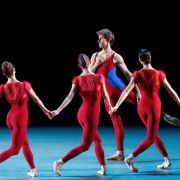
Taylor’s Airs opened on Jessica Ferretti with a faraway look in her eyes and a crew of six – barechested men, women in fluttering skirts, demigods all – who didn’t seem to see her until she activated them into a swirling, joyous circle. They flew around the stage to a mishmash of Handel, with a springiness and a delight in reversing sequences of brushing jumps.
The composer married the sensual and the spiritual, as did Ferretti with her long, lushly sweeping arms and gracefully yielding torso. Austin Kelly and Jada Pearman sought to outdo each other in a frenzy of fleet footwork. Madelyn Ho balanced on Alex Clayton’s thighs in a witty exploration of unconventional partnering holds; he made as if to launch her into orbit then brought her down to earth with heroic control. Pearman’s spinning hops on one leg were a marvel of precision and abandon. Everyone did those zany hitchkicks with a break at the hips, conjuring inexplicable joy.

Esplanade opened on an indecisive bunch of pedestrians, forever changing directions to amusing effect. By the end they were hurling themselves across the floor and hurtling into each other’s arms.
Dancers repeatedly sought solace in one another: Kristin Draucker clung to Lee Duveneck’s neck as he swung her around in wild circles; Madelyn Ho raced around the tragic mother figure of Elizabeth Chapa, repeatedly falling backward and recovering, as if trying to rescue her; Devon Louis wrapped himself around Gabrielle Barnes like a cocoon as they rolled across the floor. Wildermuth again risked all in a careening solo, launching into enormous cabrioles parallel to the floor before crashing to earth like a glorious meteorite.