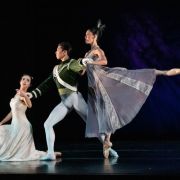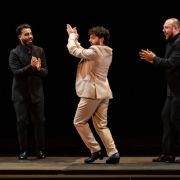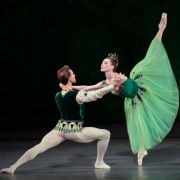


Waves of Korean Contemporary Dance at New York’s Korean Cultural Center offered a highly eclectic sampler of work channeling 21st-century anxieties and dreams with imagination, wit and daring.

From Korea, Andamiro Art Company and choreographer Kim Junghwan brought the enchanting story of an expedition to the moon in pursuit of a hidden door with the power to grant wishes. Ingenious lighting rained down in overlapping cones, accompanied by a hypnotic soundscape suggesting a bird sanctuary in outer space. A woman drifted onstage encased from neck to ankle in billowing tulle, like a giant translucent pavlova, wearing a rabbit mask that recalled the moon rabbit of Korean folklore. In hooded Tyvek suits suggesting astronaut loungewear and COVID-era PPE, Jieun Kim, Hyerin Moon and Sojeong Park moved like spacecraft mechanics doing ballet, their kicks, lunges and swooping upper bodies punctuated by the occasional entrechat. Two dancers formed the magic door by leaning into one another, hands locked overhead, while the third expended great effort and ingenuity to break through the space between their bodies.


Just as we were immersed in this gloriously absurd scenario, MOON abruptly cut off. What else did our intrepid explorers get up to in the full hour-long work? I’m dying to know.
Dancer-choreographer Lee Dongha’s harrowing Guernica Again was presented as a solo, though the version for 16 dancers must surely feel like another work. What came across with searing clarity was the terror of ordinary people facing wanton brutality, as in the 1937 Nazi bombing of the Basque town of Guernica, and the paradox of a body both vulnerable and invincible.
On a stage strewn with ash-like debris, Lee rolled in from the wings, struggled upright, writhed and sprang into the air as if buffeted by unseen forces. Stripping off his clothes, he scrubbed the ground with them, like a cleansing ritual, before laying them out as if preparing a body for burial. Nearly naked, he hurled himself repeatedly against a rubber panel on the backdrop, finally tracing his own outline in chalk – the iconic image of a crime scene.

The work also draws on the sinking of the South Korean warship Cheonan, the Sewol ferry disaster and the wartime enslavement of “comfort women” – atrocities and betrayals of the duty to protect life. Sirens, clanging and muted animal howls sustained a sense of emergency, recalling the screaming horse in Picasso’s Guernica, with a spear piercing its flank. As the light faded, Lee ran heroic laps to the swelling strains of Wagner’s Pilgrims’ Chorus, whose spiritual yearning was once appropriated by the Nazis.

Brooklyn-based WHITE WAVE Dance offered quixotic glimpses of urban life in episodes from founder-choreographer Young Soon Kim’s Here NOW So Long. In ‘What the world is made of’, Bella Donatelli suddenly hurled aside her newspaper, dove headfirst onto it, then kicked, scrunched and tossed it about to ominous chimes, while Michael Bishop read his, oblivious to his partner’s news meltdown. In an ingenious feat of virtuosity, the ensemble took turns plucking single pages from Bishop’s hands without disturbing the rest of his paper, then tore around with them, so that the pages took on a life of their own. They laid newspapers across the stage in an intense ritual on hands and knees, seemingly absorbed in searching the pages – for evidence of a crime, perhaps? Attempts to crumple the neatly arranged pages met with steadfast community intervention. Hazy live video projected onto the backdrop, layered over stills of the New York Times, heightened the offbeat atmosphere.


Elsewhere, Kaylan Bradford and Shujung Kim sat watching an animated drawing by Marissa Chen gradually furnish a domestic interior. Bradford slipped Kim’s ankle between her pointed feet and swung it a few inches – a funny, tender gesture suggesting two people building a home together.
The ensemble’s flying encounters, to wailing saxophone, piano and drums, suggested play and battle. On the backdrop, the live feed transformed into a kind of heat-mapping that rendered the dancers as animated blobs of color. Radio static and the folding of newspapers reminded me of the time in my childhood when martial law was declared and newspapers, radio and TV stations were abruptly shuttered.

Closure came as dancers carried on potted plants, to the sounds of water, thudding and sitar-like music. They shook the central stems to make the leaves tremble, then bowed their heads into the pots, arms wafting skyward like tendrils. A beautiful yet thoroughly enigmatic ending to a work full of magical energy.
The program brought to mind Korean artist Ayoung Kim’s sci-fi video series Delivery Dancers, in which gig-economy couriers race to deliver time while malign Timekeepers seek to control the multiverse by “constantly reordering time on their own terms”. The festival circuit’s practice of compressing works to accommodate more choreographers is another way of reordering time. These intriguing works deserve to be encountered on their own terms.