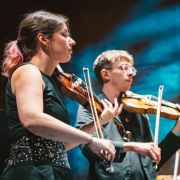


It could be argued that Leonard Bernstein was at his most truly successful as a communicator when setting text. At other times he could be discursive to a degree which must have been irritating, even to him and certainly to the listener. His mind jumped so frequently from subject to subject and from genre to genre that none of the textures were allowed sufficient time to develop. His Serenade after Plato's “Symposium”, presented as a series of discrete “Conversations about Love” almost certainly started life in the composer’s mind as a violin concerto. It was written largely in response to a request from his virtuoso violinist friend, Isaac Stern. What saved it in this Glasshouse performance with the Philharmonia Orchestra was Esther Yoo’s unearthly, pure tone especially in the higher registers, uncannily similar to Stern’s. I have never heard, since Stern's death, notes of that purity and ethereally honest, almost spiritual, texture.


This collage of out-takes from West Side Story, Stravinsky’s Violin Concerto, Bartók’s string quartets and dive bar jazz was navigated nimbly by Marin Alsop, Woo communicating constantly with the musicians around her, leaning into sections, playing towards individual musicians. In the jazz inflected sections, it was clear that from top to toe she wanted to dance, and only the conventions of formal concert programming were preventing her (also the very crowded stage, of which more later). The most moving moment came around halfway through with an extended duet passage between Yoo and Principal Cello Timothy Walden, which had depth and length enough to explore the emotional landscape underlying the work. It was a beautiful moment.
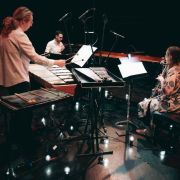
In Mahler’s Sixth Symphony, the crowded stage problem became more urgent. There were 104 players in total, including nine horns and an entire back row of percussion; from time to time a door at the side of the stage would partially open, through which could be heard cowbells and church bells, and what sounded curiously like farmyard animals.
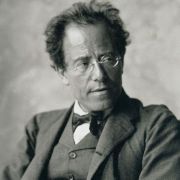
A cartoon from 1907 (a year after the premiere) showed Mahler surrounded by orchestral percussion and assorted ironmongery, smiting his forehead with the exclamation, “My God, I forgot the car horn.” This felt very much like an aural representation of that cartoon, as waves of sound, immaculately crafted but verging on damaging to the hearing, erupted from the stage with ever more urgency. The famous ‘Hammer of Fate’ made its appearance three times in the last movement and predictably broke the table on which it smote, shards flying in all directions.


It felt very much as though Mahler was trying, through creating a pastiche of his own style, to access the depth of emotion and inner landscape that he had so brilliantly achieved in his earlier symphonies. Alsop and the Philharmonia responded courageously to the challenge, but two factors were against them. It might be that an orchestra of this size is simply too big for the Sage One auditorium. I would have been interested to have heard the balance from further back, or, for example, on the third level, and I suspect this might have been rather clearer.
The other factor was the composer working against himself, and by extension against his players, in producing textures so ugly, so challenging and so difficult to love that it must have been a Herculean labour to rehearse and perform. No one could have done better than Alsop under the circumstances. She is clearly much loved by her players and by an enthusiastic young audience who responded with a standing ovation, whoops, cheers and wolf whistles. A very heartening end to the evening.