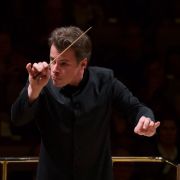
The BBC Philharmonic Orchestra began their latest concert at Bridgewater Hall with a rare performance of Lili Boulanger’s D’un soir triste. The title might suggest a sentimental miniature but in fact this was a very powerful, deeply felt piece. The orchestra’s Principal Guest Conductor Anja Bihlmaier brought out the varied colours of the orchestra: the harp and celesta had prominent roles; the bass drum and timpani brought menace to the mix. The smooth, flowing lines of the strings transformed into a dissonant climax and the piece ended in desolate quiet. There was anger and tragedy in this eleven-minute mini-drama: the “sadness” in the title is just too feeble a word to characterise it.


Zoltán Kodály lived in the village of Galánta (now in Slovakia) as a child and was impressed by the local gypsy bands. Later he encountered a collection of Hungarian dances including music from Galánta, which he used in his Dances of Galánta of 1933. Bihlmaier devoted as much attention to the orchestral detail of the Dances as she had in the Boulanger but here it was to bring out their irrepressible joie de vivre. Many soloists from the orchestra made their own characterful contributions, especially John Bradbury whose clarinet suggested a Hungarian folk instrument. Typically, tension was built up and then released in an explosion of melody. It was as if a Hungarian gypsy band had been relocated to Manchester and transformed into a large orchestra. It was hugely enjoyable.
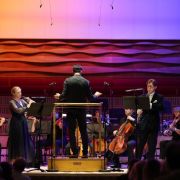
In comparison, the evening’s main work contained disappointments. Bartók's only opera, Duke Bluebeard’s Castle, is ideally suited to a concert performance as it has only two characters and no action other than the opening of seven doors to reveal what is behind them. Bluebeard was sung by baritone Christopher Purves and his new wife Judith by mezzo-soprano Jennifer Johnston. It was given in English and the text was projected on a screen above the stage, so there was no difficulty following what was being sung. The translator was not credited in the programme or in the orchestra’s website, which was unfortunate as the trochaic metres of the original seemed perfectly rendered into English. The spoken prologue was omitted. Lighting over the orchestra was used to represent the secrets behind the doors. Acting was minimal but the occasional small gesture had a big effect, as when Judith shaded her eyes as if to protect herself from the light.


Bartók deploys a huge orchestra and Bihlmaier conjured up a stunning variety of timbres. The damp castle walls felt real and Bluebeard’s kingdom must have been magnificent. Jennifer Johnston’s Judith was intense and moving. Christopher Purves’ Bluebeard was less sinister than one sometimes hears but his anxiety that Judith should not open all the doors was keenly communicated.
The problem was that the orchestra was often simply too loud. Purves’ strong baritone usually cut though the orchestral texture, but not always. Johnston suffered more in this respect. At several key moments the orchestra overpowered her, leaving the audience to rely on the surtitles. If Bihlmaier had restrained the orchestra a little, it would have made a great difference; as well as enabling the singers to be heard more clearly it could have created more variety between the scenes of the drama. If the garden as seen behind the fourth door had been more reserved, the blaze of colour for the full orchestra and organ when the fifth door was opened would have been all the greater. Much of the performance was magnificent but there were places in which it fell short.