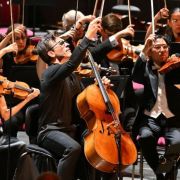
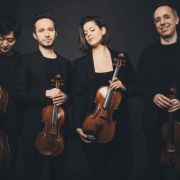
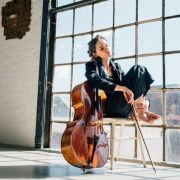
“A unique listening experience packed with unexpected connections between musical styles and genres from the widest range of times and places” is the credo behind British violinist Hugo Ticciati’s Sweden-based O/Modernt Chamber Orchestra, whose name is a play on the Swedish words for ‘old’ and ‘new’. So for him and his colleagues at least it was business as usual on Monday night, when they took to the stage of London’s Wigmore Hall with soprano Cornelia Beskow and accordionist Leo Florin, with a promise of “Viennese waltz, Slavic melancholy and Hungarian flair”, and socked out a distinctly out-of-the-ordinary explosion of genre-bending programming pizazz and musical exuberance.

The concept was to take Brahms’ String Quintet no. 2 in G major, Op.111, in Johannes Marmén’s string orchestra arrangement, and surround it by songs and short pieces by Ligeti, Bartók, Dvořák, Kálmán and Johann Strauss II that unpacked its notable stylistic elements: Viennese waltz strains, virtuoso Hungarian Romani music, Slavic melancholy... This wasn’t in itself an unprecedented programming tack to take, yet from the concert’s first note – Ticciati’s solo violin breathing slowly, duskily mysterious life into Ligeti’s 1950 Baladă şi joc (Ballad and Dance) on two Romanian folk songs – its outworking was consistently magical and narrative-rich.


The playing of the O/Modernt strings was often staggeringly nimble, superglued and kaleidoscopic; also strikingly full of folkish freewheeling freedom, earthily low-or-no-vibrato and archly solid portamento slides. Beskow assumed the mantle of gypsy storyteller with megawatt diva energy, expressivity and a darkly rich and wide soprano that, even in its lowest registers, cut through the orchestral texture like delectably warm, vibrato’d knife through butter. An early programme showstopper marrying all this neatly together was Kodály’s 1938 setting of the traditional night song, Esti dal, freshly rearranged for strings accompaniment by contemporary Romanian violinist-composer Vlad Hirlav Maistorovici: slow-moving chordal serenity; Florin’s accordion sliding in underneath so smoothly that, initially, you heard the added depth to the string sound without registering what had caused it; Beskow’s vocal legato poetry; the instrumentalists eventually adding a further layer of texture through humming.
Maistorovici was the non-Brahms composer star of the show. Besides his rearrangements of Kodály and Kálmán Hungarian folk settings, the programme was punctuated by his Carols without Words based on Romanian popular carols. All were all soul-filled creations that both honoured the darkly Slavic sound worlds of the originals, and added just the right amount of 21st-century flavoured spice via harmonic scrunches and textural complexities. Seated at the back of the hall, he was warmly applauded when Ticciati got him to stand up.
Rounding off the first half, Webern’s arrangement of Strauss’ Schatz-Walzer ostensibly brought us in from the countryside – only with its Hungarian melodic origins now inspiring a catch-me-if-you-can series of sidesteps between daintily controlled ballroom elegance and earthy folk bravado. The result was that, when after the interval Ticciati introduced the Brahms Quintet with the information that their way of playing it had completely changed as they had rehearsed the surrounding works, there was a knowing ripple of audience amusement; and striking moments across the subsequent newly minted, field-meets-town interpretation included, in the Adagio, the viola’s bar 66 weeping downwards curl being taken as a skin-pricklingly raw, gypsyish solo lament by first violist Sascha Bota, digging deep into his string.


For the concert’s grand finale, Beskow led a whirling, madcap rendition of Kalman’s “Heia, in den Bergen” from Die Csárdásfürstin. No encore was needed. And surely, somewhere in the firmament, Brahms smiled.