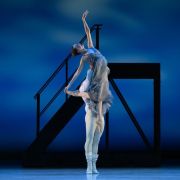
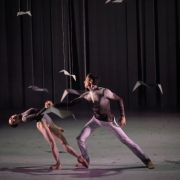
The Biennale Danza opens with two powerful works that engage directly with Wayne McGregor’s curatorial proposition, Time Does Not Exist. Through a diachronic exploration of political and cultural identity, both works suggest that dance can transform the past into lived memory, an active force that grounds individual and collective experience, challenges structures of power, shapes social relations and even provides the material from which to build the future.

The first work is Fampitaha, fampita, fampitàna (‘comparison, transmission and rivalry’), a 2024 work receiving its Italian premiere here. It is by Malagasy choreographer Soa Ratsifandrihana, who founded the Brussels-based company Kintana (‘star’) in 2025. The performance reveals how much more powerful decolonial discourse becomes when it moves beyond academic rhetoric and rationalised concepts, entering the body as lived experience.
The four performers, whose personal histories connect Haiti, Madagascar, Réunion and Rwanda, appear in colonial-style dresses and long white gloves, with Belgian and French mayoral sashes draped across their bodies. The image evokes former colonial states drawing in people who might never have wished to leave their homelands, immediately establishing the paradox of belonging and dispossession embodied by the choreography.


The movement is meticulously crafted yet resists a single language: traditional dance and voguing merge with military drills, so that the body appears both as an archive of transmission and as a terrain on which power attempts to inscribe its rules. Malagasy musician Joël Rabesolo intensifies this corporeal tension through a splendid live score that deepens the work’s emotional resonance. At one point, the electric guitar abruptly fractures the soundscape, taking on the sonic violence of gunfire as the dancers collapse to the ground in darkness.
Language is seamlessly integrated into the choreography. Ignoral, a fictional medicine made of oblivion and indifference, is invoked alongside repetitive tongue twisters and verbal drills that expose speech as an instrument of domination. A symbolic geography emerges through an imagined toponymy that includes Rue Menalamba, recalling the 1895 Malagasy uprising against French rule, alongside streets named after Haitian revolutionary Toussaint Louverture and French colonial general Gallieni, figures of resistance and repression respectively.
Through gesture and language, the piece constructs an uncompromising archaeology of memory. Dance becomes the means by which colonial history is made tangible, bringing its accumulated violence to the surface and transforming it through collective catharsis.

The second work, The Herd/Less, receives its European premiere at the Biennale. Its creator, South African choreographer Mamela Nyamza, is this year’s Silver Lion recipient. Nyamza’s work moves across ballet, contemporary dance, gumboot and butoh, using these forms to interrogate racial prejudice, gender norms and social conditioning. The award marks a further stage in the recognition of an artist whose career has repeatedly come up against the racial and gender barriers of South Africa’s dance world.
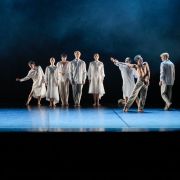
The piece examines how a group is transformed into a herd through dynamics of imitation and coercion, alongside more or less effective acts of resistance. An ensemble of women in gleaming, brightly coloured costumes, whose brilliance and variety contrast sharply with the idea of uniformity, is joined by a man dressed entirely in white. He balances a sword upright on his palm as though it were a magical object. The image suggests an unstable form of authority, precariously sustained through spectacle and threat. Uncertain whom to follow, they are left at the mercy of a leader incapable of offering direction, becoming at once a herd and a leaderless collective, as the title The Herd/Less suggests.


Nyamza brings ordinary gestures and discarded materials into the choreography. Tin cans hang above the centre of the stage, while others are strapped to the dancers’ feet, evoking the corrugated zinc sheets of the shacks surrounding Cape Town and transforming a material associated with social exclusion into choreography, scenography and sound. The performers’ restricted movement mirrors the living conditions on the city’s outskirts, while every step produces a harsh metallic resonance, so that the very constraint imposed on the dancers becomes the performance’s score. Further rhythms emerge from shaken bracelets, rubbing hands, whistles and other forms of body percussion, alternating between mounting intensity and quieter passages.
Whenever a gesture enters the choreographic system, it is echoed and replicated. Movement spreads through the ensemble like a contagion, becoming repetitive to the point of paroxysm. The group also absorbs gestures of masculine gang posturing, showing how intimidation and violence circulate socially through imitation. Nyamza’s courage and originality lie in forging a language entirely her own, even when its insistent repetition risks testing the audience’s endurance.
In both works, the body emerges as the battleground between power, exercised through discipline and coercion, and the individual, with all their vulnerability, suffering and irrepressible capacity for beauty and freedom. The strength of both pieces lies in their ability to translate these political mechanisms into choreographic form with immense emotional force. Together, they provide an explosive opening to this year’s festival.