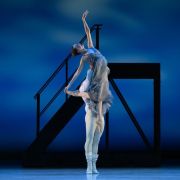
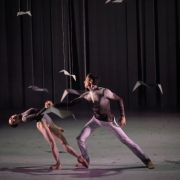
WINNDance, an acronym for When, If Not Now?, is a remarkable new project guided by Vyacheslav “Slava” Tutukin and Marijn Rademaker. Bringing together dancers over forty, around the age at which many ballet performers formally retire, the Stuttgart-based company offers a concrete response to the challenges posed by the ephemerality of a dancer’s career and resonates closely with Wayne McGregor’s theme for Biennale Danza 2026, Time Does Not Exist. Its world premiere brought the festival to a close.

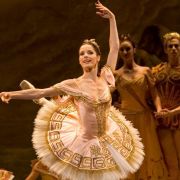
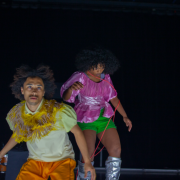
An extraordinary constellation of dancers assembled on stage: Silvia Azzoni, Kayoko Everhart, Mara Galeazzi, Silas Henriksen, Igone de Jongh, Marijn Rademaker, Oleksandr Ryabko, Gil Roman and Diana Vishneva. Their presence alone would have made the evening one of the most significant dance events of recent years, and the performance fully lived up to that promise. Dancing together with what felt like an immediate mutual understanding, they brought extraordinary generosity and intensity to the stage, leaving the audience breathless and profoundly grateful.


The programme takes the form of a two-part, Venice-inspired work entitled Scirocco, named after the hot, humid, dust-laden wind that blows from the south and is interpreted here as a destabilising force capable of unsettling certainties. Forget Carnival, commedia dell’arte, the Regata Storica, the colourful worlds of Goldoni and Casanova, and the city’s exuberant cosmopolitan vitality. Instead, the evening embraces Venice’s melancholic beauty and fragile decadence, dwelling on loss, longing and finitude through two pieces, Death in Venice and Bridge of Sighs.
Death in Venice is presented as a meditation on the conflict between social identity and inner truth, and on literature as a space in which the latter may find expression. At its centre is Thomas Mann’s novel, with its atmosphere of desolation and its longing for beauty and the ideal. Through dance and film sequences directed by Javier De Frutos, Mann is brought into dialogue with his protagonist, Gustav von Aschenbach, opening up a reflection on art, yearning and mortality.

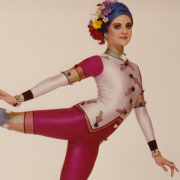
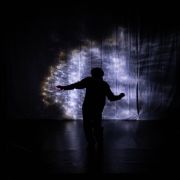
Its three sections, choreographed by Imre and Marne van Opstal, Omar Román De Jesús and Rainer Behr, display a striking stylistic coherence: restless, intensely expressive movement, distorted shapes, disrupted lines and intricate partnering. All the dancers more than live up to their reputations, with Everhart displaying exquisite elegance, softness and precision, and Henriksen dancing with such energy and beauty of movement that it is impossible to look away. Dressed in fluid menswear that is gradually deconstructed, they move through clouds of smoke to a heterogeneous score featuring music by Ricardo Villalobos, Mohammad Reza Mortazavi and Hildur Guðnadóttir, unified by an atmosphere of unsettled energy and troubled desire.


Bridge of Sighs, by John Neumeier, continues along the same emotional trajectory. Inspired by the Ponte dei Sospiri, evoked on stage by a stepladder, the work recalls the walkway through which prisoners were traditionally said to catch their final glimpse of Venice. Neumeier’s point of departure is a passage from Saint Augustine’s Confessions: “I was not yet in love, but I was in love with loving”. With his characteristic clarity of theatrical construction, Neumeier offers a finely controlled exploration of objectless love, of desire directed towards desire itself, through sculptural tableaux, weighted embraces and charged encounters performed by seven members of the cast, all except Roman and Everhart. Set to Shostakovich and songs by Kurt Weill and Friedrich Hollaender, the piece unfolds as a lyrical succession of conflict and tenderness, cries and poetic resignation. The final appearance of a young boy, running and dancing joyfully across the stage, introduces a wonderful note of vitality and lightness.

WINNDance is an exciting and much-needed initiative, with ambitious plans for artistic collaboration and education, and a commitment to creating new possibilities for dancers at different stages of their careers. It rightly celebrates artists who have helped shape international dance, placing their accumulated experience and interpretive depth at the centre of its vision. Yet its inaugural programme presents a curious paradox, introducing the company through images of finitude, nostalgia and decline. Contradiction, and even mourning, have nourished art for centuries, however, and if WINNDance builds upon this very paradox, it may lead the company towards an all the more compelling and prosperous future.