Under the artistic direction of Wayne McGregor, Biennale Danza’s annual calls for new choreographic works have become a significant platform for emerging talent.

Previous editions have supported a range of ideas, from somatic study with an architectural dimension (Luna Cenere), postcolonial reimaginings (Andrea Peña), explorations of human anatomy (Diego Tortelli), and East Asian martial traditions (Po-Cheng Tsai and B.DANCE), to urban dance languages (Vidavè), fusions of hip-hop and breaking (Miller de Nobili), philosophical reflection (Philippe Kratz), and collisions between queer performance, pop music, and working-class politics (BULLYACHE).
At a time of increasing dematerialisation, this year’s selected artists turn their attention towards material culture, sharing a conceptual inquiry into our relationship with everyday objects and inviting us to see them in a new light. Andrea Salustri, winner of the Italian call, employs basic natural elements and devices to question the limits of sensory perception. Recipient of the international call, Oli Mathiesen, turns instead toward sacred iconography, dissecting seemingly familiar religious symbolism.


Following the success of Materia (presented in Venice in 2023 and widely toured across Europe and Asia), Andrea Salustri, alongside collaborator Alice Rende, orchestrates an array of devices that produce smoke, whirlwinds, light, and mist to concrete music by Federico Coderoni. Props interact directly with the somatic dimension, amplifying the performative body through iridescent reflections, moving fogs, and light beams turning into vibrations and acoustic waves.
At other times, the duo glides with feline grace, operating like black cats in the night, making objects dance to their own music through a system of microphones. An electric kettle pipes, and tubes filled with moving water are left on stage like a bizarre concert ensemble to take on a life of their own, conversing in their liquid language. Electricity and water react to unleash a final storm and a gigantic pirouetting whirlwind, while Salustri, manipulating objects with a fluid enchantment reminiscent of his origins as a street artist, navigates the stage like an elegant Noah in the deluge.

The result is a dance of the invisible that enhances the ephemerality at the core of any choreutic performance. Stemming from his background in philosophy, Salustri’s expanded view of choreography enlarges everyday life, poetically uncovering its unthinkable and surprising nature, implicitly raising questions about our synecdochic relationship to the world, perception and cognition, the prominence of process over product, marvel as the source of reflection, and the opaque and ungraspable as a catalyst for art.
All of this is captivating, technically ambitious and conceptually dense. Nevertheless, one is left wondering whether the breathtaking spectacle of objects dancing, might belong to the world of art installation rather than dance.
If Salustri’s work is a distillate of minimalism, Oli Mathiesen’s Just Between Me and Jesus is boisterous, loud and truly maximalist, delivering a display of subverted Christian symbols set to a relentless techno beat. Based in Aotearoa (New Zealand), Mathiesen embeds his ancestry within the Ngāpuhi, Ngāti Hine and Ngāti Manu iwi directly into his choreographic methodology, forging a deeply original contemporary language.


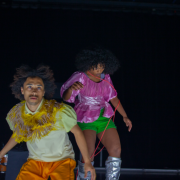
On stage, framed by silver chains suspended as scenography under colourful lighting, six exceptionally skilled performers throw themselves entirely into the movement. They exude a genuine sense of enjoyment that radiates an infectious nightclub energy, dressed in a fusion of streetwear contaminated with fragments of traditional Christian imagery. The choreography merges commercial club steps with traditional Māori movement, reflecting a dynamic collision of belief systems and the search for identity and belonging that both religion and dance represent. Crafted by sound designer Alistair Deverick, the soundscape mixes techno with a range of audio textures, punctuated at times by church bells, and at another by an incessant chant of “Set me free”.
Attempts at dramaturgy emerge when the dancers display sudden fear, a thirst for the transcendent, or occasional fights and reconciliations, as well as when a performer is seen praying while trembling within a tight beam of light. Their execution is marked by extraordinary athleticism and total presence, shifting between relentless energy and an uncanny terror. Ultimately, the piece appears to depict the rave as a religious experience, yet leaves it ambiguous whether salvation or damnation awaits, though the tilted cross of blazing monitors leaning in toward the finale strongly suggests the latter.
Everything seems driven by a push toward the irreverent. The aesthetic hovers between a Lady Gaga music video, Thomas Jolly’s Olympic opening ceremony, and the provocative staging of opera productions such as Lydia Steier’s Salome. The stage is laden with charged imagery – from a performer draped as the Virgin Mary in the opening to an apple devoured while a dancer is held upside down. Yet, religious innuendo and devotional motifs are hardly groundbreaking provocations today, as the formula seems to have long lost its punch through sheer repetition.