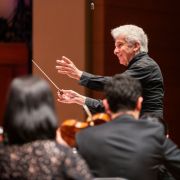
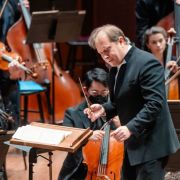
Seattle Symphony Conductor Emeritus Ludovic Morlot believes autumn is an ideal time for spring-like renewal celebrations. For his latest performance, he continued the orchestra’s season-long exploration of the natural world by programming three spring-themed works, initially generated from his interest in Samuel Adams’ piano concerto, No Such Spring.

He opened with British composer Frank Bridge’s Enter Spring, a zestful if dissonant portrayal of the ecstatic reawakening of the colorful, birdsong-infused English countryside. The 1927 premiere conducted by the composer so impressed the young Benjamin Britten that it led to a lifetime relationship of studying and mentorship with Bridge. Alternately called a symphonic poem and a rhapsody for orchestra, the piece evokes Elgar’s In the South, Ravel’s La Valse, and the tone poems of Richard Strauss. Morlot first emphasized the work’s French sensibilities and rhapsodic qualities, with its playful, bird-like ‘forest murmurs’ flute and oboe interplay and magical harp glissandi, then generated an immense, Scriabin-like wash of sound, progressing toward an exuberant conclusion.


Seattle-based composer Samuel Adams wrote No Such Spring during the pandemic, dramatizing a violent spring awakening after two years’ silence. Commissioned by the San Francisco Symphony in 2023, the work premiered with conductor Esa-Pekka Salonen and pianist Conor Hanick, the soloist in Morlot’s program. Energetic and dynamic, No Such Spring combines the minimalism of Philip Glass, Steve Reich, and the composer’s own father, John Adams (the latter’s piano concerto, After the Fall, references his son’s work), and quotes Stravinsky’s Sacre du Printemps. The younger Adams’ inventive use of brass and percussion, with the added intrigue of the Moog analog bass synthesizer, reflects the solo piano’s patterns and instantly grabs the listener’s attention.
Using minimalist repetition throughout, the three movements form a continuous cycle. In Colorfugue, an undulating one-finger solo piano intro develops with Stravinskian syncopations and varied orchestral colors. Two contrasting themes and alternating sets of variations build toward a huge collision. In the final movement, Garden of Wire and Wood, piano and orchestra generate, to quote the composer, a “garden of sound” seemingly pointing toward the unknown. At its peak, the volume was a challenge to the ear.
Hanick, whose repertoire includes trailblazing composers Ligeti and Babbit, played with the keen understanding that comes from having performed the piece from its inception. His solid technique, intelligence and grasp of the instrument’s tonal capabilities gave the listener a panoply of effects to absorb. Morlot admirably controlled the complicated score. The horn playing was exemplary in both the Adams and Bridge pieces.


The two previous spring-themed works led to Morlot’s choice of Robert Schumann’s romantically jubilant Spring Symphony, written in midwinter in anticipation of the season of renewal. Morlot gave the score freshness and breath. In the first movement’s Andante un poco maestoso, which Schumann originally named “The Beginning of Spring”, Morlot began with the authority and dignity befitting Schumann’s declamatory style and followed with crisp energy in the Allegro molto vivace. The coda, interpreted with sweet sentimentality, anticipated Morlot’s touchingly emotional rendition of the following Larghetto, embodying the composer’s newly experienced marital happiness with Clara.
In the final two movements, Scherzo and Allegro animato e grazioso, Morlot’s vigor was infectious, his snappy tempi adding to the effect. The orchestra responded with a gusto that personified spring’s cheerfulness. The violin sections skillfully negotiated the fourth movement’s tricky passages.
Morlot conveyed a deep love of the music and cognizance of the composer’s characteristic fragility. His was a subtle, understated interpretation, which aficionados of Schumann’s music could clearly appreciate.