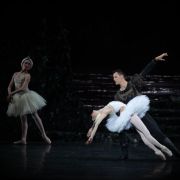
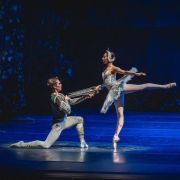
If dance were ever divided into chalk and cheese, then this would have been the ideal example. Tutus and hoodies; pointe shoes and bare feet; classical ballet and physical theatre. Listening to audience members in the margins of this performance it was clear that some preferred the ultra-modern approach to dance theatre, while others preferred the contemporary feel to classical ballet. With one significant exception, I fell firmly into the latter camp.

The young dancers of Polish National Ballet were an absolute joy, a huge credit to their teachers and to the company in Warsaw, especially since the Junior Company, which is led by former Royal Ballet soloist, Dawid Trzensimiech, was only created three years ago!
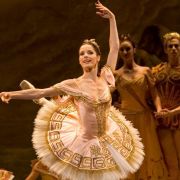
Trzensimiech choreographed the evening’s opening work, Reverentia, to the emotional intensity of Ignacy Jan Paderewski’s Piano Concerto in A minor. It was an exercise in pure ballet, with wave after wave of dancers – surprisingly there were only eight altogether – delivering impeccable exercises in classical language. Without exception, the quality of the dancing was redolent of already being a professional ensemble.


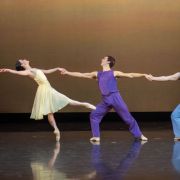
The confidence of Martyna Wrzesińska had already declared itself in Reverentia, before being emphasised yet further in the more intimate duet, Verses, by Robert Bondara, created to the music of Ólafur Arnalds and Alice Sara Ott. Antoni Casti wore just trousers while Wrzesińska was in singlet and tight green shorts, costumes that allowed the muscular landscape of her legs and his upper body to be fully exposed. We don’t see much of Bondara’s work in the UK, but this was a beautiful calling card.

I have long been an advocate for Anna Hop’s innovative approach to choreography and her interpretation of Erik Satie’s Gnossienne No. 1 was a fascinating mix of a duet for two dancers (Klaudia Sarna and Kajetan Stabeusz) but also their silhouettes, skilfully cast onto the backdrop so that their shadows interacted as well as their bodies. I suspect that Hop is unfamiliar with the choreography of Russell Maliphant, but she had a lot to live up to in comparison with the latter’s Afterlight to the same music, and to his own experimentation with light and silhouettes over many works. Hop’s brief piece achieved a significant impact as an outstanding example of contemporary ballet. Surprisingly, there was no credit for a lighting designer, which leads me to believe that the multi-talented choreographer was also responsible for this creative contribution.
The final entry in this trio of brief pieces for the Polish ensemble was Antonio Lanzo’s Rumänische Volkstänze, made to the Romanian folk dances of Béla Bartók, arranged for a trio of dancers, Klara Melerska, Maja Augustyniak and Kyle Lippoth, scantily clad in orange (just tight shorts for the man, short dresses for the women) against a kaleidoscopic back projection. Their performance continued into a choreographed curtain call with the dancers flattening their bodies into two-dimensional art deco ceramic poses.

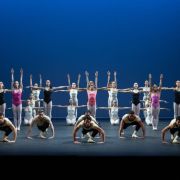
The final Polish contribution to the evening was Katarzyna Kozielska’s Fluxus, an elegant work for eight dancers, created to Phillip Glass’ Violin Concerto No 1. The choreography and its performance were enhanced by Emil Wysocki’s impactful costume designs with the four men in sheer black outfits heavily contrasted with the four women’s light green bodices and short skirts. It was an appropriate sign-off for a company that showcased consistently high-quality work with outstanding performances from these talented dancers, every one of whom deserves the opportunity of a satisfying professional career.


By contrast, the three contributions from the Rambert School were a mixed bag. By far the most intriguing piece was Ben Duke’s Session 1, a stimulating piece of dance theatre for just six performers that contemporised Hamlet into a modern-day drama interpreted through sessions with a psychotherapist: “She married my uncle only six weeks after my father’s death!” Typical of Duke’s work, it was funny, poignant and thought-provoking with the six performers continually interchanging roles. If I have a criticism, it is simply that they were not as comfortable with their spoken text as they were in their movement.

Holly Blakey’s Blues in Three is the kind of highly intellectual work, apparently focused on mental health issues, that I suspect needs to be viewed several times to be fully appreciated. After a single viewing, I was left nonplussed, although in awe of the multifarious skills of these young dancers. One young man performed the same acrobatic routine involving a back roll into a reverse handstand so many consecutive times that I lost count. It was the kind of routine that Cirque du Soleil would sign him up to do for a whole career!
The final work was Alesandra Seutin’s Outside the Stadium, another large-scale piece for thirteen dancers who seemed to parody some kind of sporting activity – a lot of running was involved – wearing grey shorts and vests. There is no denying the energy and commitment of these dancers, but it left me rather underwhelmed.