It’s a crying shame that 2026, the bicentenary of Carl Maria Von Weber’s death, is passing virtually unrecognised by British opera companies. Weber was a pivotal figure in German opera and is one of those many composers who died far too early while making a tremendous impact in the scant years afforded them. Credit must be given, then, to the BBC Proms for programming his most awkward work, Oberon, also in its bicentenary year.

Readers will be familiar with the name of the title character from A Midsummer Night’s Dream, but the text by librettist James Robinson Planché is actually taken from a German poem based on a medieval French work; a domestic dispute between Oberon and Titania provides the framework for a ludicrous quest that involves mermaids, a Baghdadi princess and a series of deus ex machinae. It’s completely absurd, dramatically questionable and redeemed by some ravishing music that repeatedly reminds the listener of what an inventive and ingenious melodist Weber was. Oberon was written for Covent Garden, and it is said that the strain of writing and rehearsing the work accelerated the composer’s death. It’s a work that’s tricky to stage, and giving it in a semi-staging at Royal Albert Hall avoided some of the obvious dramatic challenges.


The greatest of these challenges, and one that alas this performance by Sir Mark Elder – always willing to champion unusual repertoire – and the Orchestre Révolutionnaire et Romantique was unable to overcome is the large amount of spoken dialogue; this performance dealt with it via a narration entrusted to actress Tamsin Greig in a new text by Timothy Knapman. At its best it was corny; at its worst, it was excruciating. Greig’s theoretically wry delivery of the trendy, hip lines felt juvenile and often fell flat, hindered by the insistence on surtitles for miked speech which removed any spontaneity, while the modern tone of the text itself was jarringly at odds with the high language of what was being sung. There is no satisfactory way of tackling the rather clunky dialogue and how it engages with the music; save for the text and delivery, stage director Emma Doherty’s choreography and final conceit – the Narrator is Titania – worked well. Doherty moved her singers, clad in modern dress, around the stage, both in front and behind the orchestra, and did so in a way that mitigated the challenges that the venue’s acoustic presents to the performers.
Narration complaint aside, the music was handled commendably by the performers. Charles Castronovo had originally been scheduled to sing the meatier tenor role of Huon; John Findon sang in his stead and gave a dynamic and melodious interpretation of the role. Much of the music is written for the upper reaches of the voice, and Findon’s bright and vibrant tenor seemed comfortable and unforced, with only a touch of slightly clunky gear-changing in the demanding coloratura. In his Reiza, Jennifer Davis delivered a standout performance, showing a crystalline soprano which filled the hall. High notes were secure, phrasing clean and colouring varied, with only a little blurring in her diction.


Nicky Spence’s slightly grittier tenor made a fine contrast to Findon’s, and that sense of articulation and innate theatricality was present in every line. Spence also gave every impression of having a thoroughly good time on stage, bustling imperiously while obviously not taking himself too seriously. A smaller role, but as Fatima, Rachael Wilson showed a plangent mezzo-soprano, bringing simple elegance to her Act 2 arias. Baritone Yannick Debus brought comic energy to Sherasmin, but J’Nai Bridges – a late stand in – seemed vocally slightly miscast as Puck despite her fine dynamic with Spence, struggling to project and lacking punch.

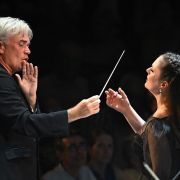
On the podium, Elder revelled in Weber’s glimmering textures; a touch lethargic in the slower parts of the overture, but energised in the brisker moments. Singers were rarely pitted against the orchestra, and with the exception of a single horn fluff at the beginning, the brass – particularly exposed in this work – was excellent. It’s to be regretted that Oberon has so many structural issues; musically, it’s a delight and deserves to be heard, even if not seen.