If I had a euro for every German opera that featured a main character undergoing a spiritual transformation by the hands of Egyptian gods, I would have... two euros. Which isn’t much, but still enough of a noteworthy coincidence. Unlike Die Zauberflöte, however, the initiation ritual in Matthias Pintscher’s new opera Das kalte Herz veers towards dark, dismal territories, quite inhospitable for eccentric birdcatchers and villainous coloratura divas. Violence and trauma lie at the heart of Pintscher’s first theatre piece in more than two decades, prompted by none other than Daniel Barenboim. With a libretto by Daniel Arkadij Gerzenberg, Das kalte Herz finally debuted at the Staatsoper Unter den Linden, entrusted to director James Darrah Black and Pintscher himself on the podium. Regrettably, the outcome left much to be desired, making for a difficult winter premiere.

On paper, Gerzenberg’s libretto is a free adaptation of Wilhelm Hauff’s 1827 fairy tale of the same name. The source material shrouds a budding anti-capitalist critique with Romantic tropes, following the vicissitudes of poor Peter as he trades his heart to a sorcerer in exchange for a good fortune and a new heart of stone. In practice, Gerzenberg’s retelling in twelve tableaux does away with forest sprites and satanic envoys, replacing them with equally arcane figures: the Egyptian god – in the opera, goddess – Anubis, usher of the dead into the underworld, and Azaël, a fallen angel from the Hebrew Bible. More than half of the opera goes by waiting for Anubis, a risky choice that would have required both a tighter libretto and score.


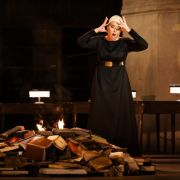
Darrah Black’s production matches Pintscher and Gerzenberg’s opera in that they both require patience. The curtain opens on a bare stage, where a low screen with projections of a forest marks off the proscenium. Above and behind it, ropes hanging from the ceiling hold something hidden. In this setting, a woman explains to a child that the gods demand a sacrifice; soon, Peter enters the stage, visibly tormented and incapable of communicating with his lover, Clara. Peter seems to be paralysed by subconscious anguish, visualised by the revelation of what is hanging from the ropes: two rows of dead wolves, at once Peter’s alter ego and a first hint at Anubis. Most of the opera unfolds in this inert environment, which wouldn’t be too much of a problem if the plot moved forward. Instead, the libretto bogs down in a constant repetition of lines and situations, in anticipation of the arrival of Anubis – who, through Azaël, tells Peter’s Mother that her son has been ‘chosen’ for a mysterious sacrificial ritual. When Anubis finally appears, a bright red background and her hieratic, campy garments offer a welcome change of scenery. And yet Darrah Black gets stuck here, too, so that the emotional core of the opera – Mother telling Peter that she is responsible for his angst, after Anubis removed his heart – is accompanied by the baring of an already bare stage.

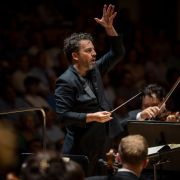
Pintscher’s score is also wary of grand revelations and plot twists. The orchestra is always in motion and mostly atmospheric, suggesting the murmur of the forest through microtonal movements and pointed timbral choices. It’s hard to imagine better conditions to listen to an opera – conducted by its own composer, with the ensemble that he had in mind while composing. Pintscher embeds low brass, harp and metallophones into the score’s undergrowth, filling the theatre with whispers, cracks, gusts and whistles, but also straying towards a more openly hostile, industrial sound. When melody does emerge, it comes attached to specific timbres and usually in relation to a character (Clara's oboe) or a situation (the opening cello).


Much of the melodic appeal in the score is also to be found outside the pit. Every part is a testimony to the composer’s fascination with the human voice, a most intimate instrument in direct contradiction with the opera’s stone-cold heart. Samuel Hasselhorn’s Peter was a masterclass in singing, clipped by clumsy stage directions. His baritone sounded soft, rich with harmonics and nearly inexhaustible throughout the messe di voce, long notes and falsettos. Highlight of the evening was his “Ich fühle nichts” (I feel nothing) soliloquy, where the character is left alone on stage to sing unaccompanied. Sophia Burgos sang Clara with a beautiful soprano, sporting a pleasant fast vibrato and occasionally a fine, agile coloratura. In the spoken role of Azaël, Sunnyi Melles indulged in a sadistic, almost animalistic approach, turning her voice into an inhumane and sinister sound. Rosie Aldridge completed the cast as Anubis, her mezzo also occupied in a few good vocal runs that contrasted the statuesque stillness of her costume. Hopefully, we will get to hear the members of this talented cast on better occasions.