With ventriloquized birds, curly yellow wigs and a harpsichordist forced to defend himself from a soprano ready to make off with his sheet music, Opera Lafayette’s Les Surprises de l’Amour had the unusual virtue of being at least as funny as it was trying to be. Jean-Philippe Rameau wrote the 1748 version for Madame de Pompadour’s theater at Versailles, where the solo roles were sung by the Marquise and her cultivated circle of court amateurs, with professionals making up much of the chorus and orchestra. Commissioned to celebrate the Treaty of Aix-la-Chapelle, it moves from Astrée interrupting Vulcain’s manufacture of weapons to an enchanted lyre dissolving Uranie’s resistance to love, followed by Venus and Diana contending for Adonis. The original, ostensibly not fully staged for over 250 years, was a fitting start to Opera Lafayette’s Rameau 350 project.

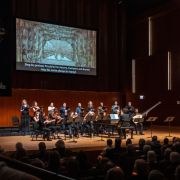
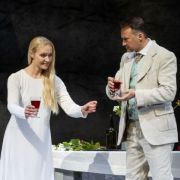
At Hunter College’s Kaye Playhouse, nearly half the stage was occupied by Patrick Dupré Quigley and the Opera Lafayette Orchestra. That left precious little space for an opera-ballet, but director Chas Rader-Shieber managed it well. His performance-within-a-performance placed Madame de Pompadour and King Louis XV at the side of the stage, where they watched the court entertainment until Pompadour stepped into her various other roles. Jimmy Stubbs’ light scenery and simple yet clear costumes reinforced the jovial feeling that this professional production was, in fact, an elaborate private playdate for a very well-coordinated group of friends.


Constrained between the orchestra and platforms hosting singers and spectators on either side of the stage, the four dancers had shockingly little space to move through. But within Isaac Lerner’s choreography based in classical ballet and mixed with some contemporary spice, they collectively succeeded in moving the story forward with athleticism and grace. Matthew Spangler was especially good, both in his apparent command of gravity, as well as in his robust commitment to character. While perfectly proficient in his turns, he also managed to dance quite legibly with his face.

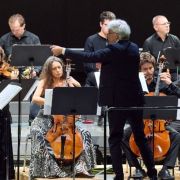
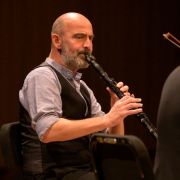
With Quigley conducting, the Opera Lafayette Orchestra kept the lower sonorities warm and distinct, never allowing the unusually bass-heavy scoring to blur Rameau’s dance rhythms. Percussion gave those rhythms a crisp, satisfying bite. In Adonis, the piccolos broke through the warmer orchestral texture with a piercing, almost recorder-like brightness, one of the evening’s most distinctive instrumental moments.
The cast’s French was exceptionally well articulated, allowing ornament, color and comic inflection without sacrificing the words. The strongest solo singing came from Elizabeth Sutphen, whose Uranie and Venus combined vocal control with a sharp understanding of the comedy. Uranie’s surrender to Cupid’s enchanted lyre was skilled and convincing. Connie Yun’s accompanying lighting was dramatic and precise, with a sudden shift at the moment of enchantment that gave the scene disproportionate force. As Pompadour in the framing action, Sutphen was also irresistibly funny as she badgered the King to prepare himself to be amazed by the next spectacle.

Vulcain brought out the best in baritone Hadleigh Adams: each note was confident in its shape, floating out into the audience with warmth and fullness; his Linus was not as absurdly beautiful. As Astrée, soprano Emilie Kealani’s voice was bright and sweet, but still substantial; for Diana, she produced a rougher sound, suitable for the rougher character. While Kayleigh Sprouse’s first lines felt somewhat hollow, her soprano quickly bloomed into something nuanced, remarkable and perfect for her playful, demanding roles. By the time she reached Cupid, her voice projected much further into the room, carrying a bouquet of colors with it.


One of the great highlights of the night – an obvious audience favorite – was the actor-chorus, who moved through the stories with a bit less physical grace than the dancers, but all of the good humor. What’s more, the eight of them could each be heard distinctly, though they blended lusciously. Tenor Patrick Kilbride repeatedly caught both eye and ear, with a gorgeously spacious voice and unabashedly sassy acting as one of the new conscripts into Cupid’s army, and as a somewhat malfunctioning tree.

The overall effect of the performance was like reaching into the coat pocket of history, only to find an unexpected still-wrapped, lint-free, perfectly delicious piece of candy. Technically, it was a production that showcased respect and love for all of the participating artists. As Cupid sings, “to love is to know everything” or at least everything necessary to successfully stage an obscure and complex production on the head of a pin.