It’s an opportunity too good to pass by when the main piece on the programme calls for a battalion of brass players. All 23 formed a single line across the Usher Hall’s organ gallery, a visually arresting spotlight sight as they opened with Copland’s famous Fanfare for the Common Man. Players, timpani, bass drum and tam-tam held nothing back in this glorious blast, written to boost wartime morale in the USA. In besieged Leningrad, Shostakovich was also composing, so the Copland was a teasing warm-up for a very different musical canvas to follow.

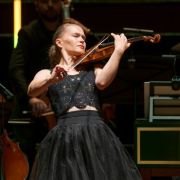
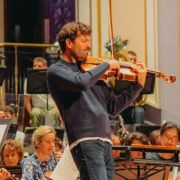
The Royal Scottish National Orchestra recently recorded Lera Auerbach’s Violin Concerto no. 1, a work written for Philippe Quint in 2004. He was again the soloist at this performance, the work’s UK concert premiere. The complex piece in four movements began with huge crashes in the orchestra as Quint embarked on a sprightly but rather lone impassioned journey. I enjoyed the varying orchestral textures, including an ethereal musical saw mysteriously floating notes as dream worlds were explored, the bass clarinet adding a sinister edge.


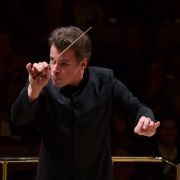
The work cycled from a creepy Scherzo to quiet turbulence with soft woodwinds, violas edging up the momentum before urgent rhythmic unison introduced the final movement, horns calling across a frantic landscape. Conductor Bassem Akiki, making his first appearance with the orchestra, kept things tightly controlled, a flute solo with twinkling celesta introducing Quint’s formidable cadenza peppered with double-stopped passages. Even with its considerable orchestral interest, and Quint’s expressive performance, soloist and players seemed to be on divergent paths at times.

Akiki returned to the platform changed into an eye-catching brick-red suit to conduct Shostakovich's Symphony no. 7 in C major, "Leningrad" but he was not the only new face. The RSNO was augmented with young players starting their professional careers from Sinfonia Smith Square, bringing some to Scotland during the renovation of their London home in a new partnership. With nine horns in a single row, separating antiphonal groups of brass players, the huge forces promised to raise the roof in the exuberant passages of this extraordinary symphony, whose every performance is an event. Shostakovich was a relief fireman in Leningrad, evacuated by the Soviet authorities to compose the work in exile in Kuybyshev where it was premiered by the Bolshoi Orchestra. Used as propaganda to terrify the invading Nazis and boost Soviet morale, the work was intended not to focus on the city’s siege but rather on the results of war and revolutionary purges.


The RSNO have Shostakovich in their bones and tackled this work with terrific playing. Akiki put his own stamp on the ebb and flow, which at times allowed the tension to dip, but he successfully set the scene in the first movement with its grave opening theme, his balletic conducting urging players on. Woodwinds shone, softly piercing flute and querulous piccolo deepening the intensity as the soft snare drum emerged. Oboe and bassoon passed phrases as the music grew with the massed brass exploding into the terrifying climax of the invasion music, before things subsided into calmer territory, a comeback march headed off. The pleading oboe in the Moderato was overcome by purposeful strings, turning into a triumphant dance, but the shivers returned with bass clarinet, harps and alto flute adding poignant depth.
A moving wind chorale and impassioned strings opened the Adagio, a double bassoon adding growl, Akiki building agitation once again before the warm violas provided consolation and hope. The final Allegro was a colossal journey, packed with raw energy, fretboard pizzicatos flying as the work grew to its blazing conclusion and memorable impact.