There were two surprises in this gala performance. The second may have been predictable, given the occasion, but the manner of it was superbly contrived. The whole evening was a tribute to the Founding Director of Birmingham Royal Ballet, Sir Peter Wright who will reach his centenary on 25th November 2026.

At the end of the performance there was a brief film tribute to Sir Peter, after which the screen was raised to reveal the man himself, seated on an ornate throne and waving to the audience for all his worth. This led to an erudite speech from the BRB chair, Sir David Normington and a mass of former and present BRB colleagues surrounding Sir Peter onstage.
Standing next to him was the second of the evening’s surprises. Not that Carlos Acosta was there but that he still wore the sombre costume of Death from the final work of the evening, Kurt Jooss’ seminal anti-war ballet, The Green Table (1932). Sub-titled A Dance of Death in Eight Scenes, it’s a challenging role and, just a few days after his 53rd birthday, Acosta looked in great shape in the extraordinary, revealing costume, face paint and headdress. The movement of Death is ponderous with heavy feet and statuesque poses, all of which Acosta delivered with panache.


The Green Table was already sixty years old when it was first revived on the company, then only just two years in Birmingham. Wright’s commissioning of the ballet is only one of the reasons for its place in his celebration since he began his own dance training with Ballet Jooss in 1945 and performed as one of the soldiers.
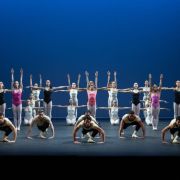
Before the company danced, the audience enjoyed a Défilé of the students from Elmhurst School of Ballet, performed to Tchaikovsky’s Polonaise from Eugene Onegin in a choreographed mass procession by Misha Tchoupakov, followed by a speech and a poem from Acosta (prior to his costume and make-up as Death) in which he declared that Sir Peter did not just make ballets, “he built worlds”.

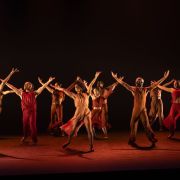
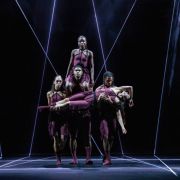
The revival of The Green Table was the highlight and the BRB dancers tackled Jooss’ choreography, which exists at some distance from classical ballet in the hinterland of modern movement, with aplomb. It is an anti-war polemic that opens and closes with the iconic scenes of caricature around the eponymous table with ten masked “Gentleman in Black”, wearing white gloves, dress suits and spats.
Their comic-book movement to incongruously jolly music, around and on the table, indicated the nonsense of peace talks by those invested in the proceeds of war and uninvested in its consequences. At one point they seemed to be group snorting cocaine from the table; they pointed fingers; and carried out a mock fencing match. The opening prologue ended with the ten men (three of whom were male-presenting women) firing blank pistols into the air, causing some shock amongst the audience. The closing epilogue began with the same shot-firing before continuing into an exact repeat of the opening sequence. Given the attention to peace talks in today’s world, these scenes are all-the-more poignant in their continued relevance.

The intervening scenes include harrowing sequences of a battle and ensuing refugees, with Gabriel Anderson as the Standard Bearer swishing his flag like a flamenco dancer with her shawl. Max Maslen and Tom Hazelby were the Old and Young Soldiers flanked by Death; Samara Downs, the grief-stricken Mother, and Riko Ito hovered through the piece as the sleazy Profiteer in his bowler hat. The double piano playing of Fritz Cohen’s memorable score, which is so redolent of the 1930s, was superbly rendered by Jeanette Wong and Yen Lee.


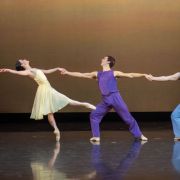
Much though it was enthralling to revisit the history of The Green Table, the choices of four extracts from 19th-century ballets that Sir Peter had a hand in adapting were predictable and somewhat weakened by being taken out of their context. They began with a sizeable extract from Act 3 of The Sleeping Beauty, in which Momoko Hirata sparkled as Princess Aurora, securely partnered by Mathias Dingman; followed by Beatrice Parma and Tzu-Chao Chou giving a charming account of the Act 3 pas de deux from Coppélia; and then Miki Mizutani in the title role with Maslen as her Albrecht in the ethereal Act 2 pas de deux from Giselle.

These were appetisers for a lengthy but nonetheless abridged version of Act 3 from Swan Lake, incorporating a sumptuous Czárdás, led by Ava May Llewellyn and Louis Andreasen, followed by a raucous Neapolitan and an elegant Spanish dance as a prelude to the Black Swan pas de deux, performed with tenacious verve and seductive expression by Céline Gittens as Odile opposite a rather cool and surprisingly detached Siegfried (Yasiel Hodelín Bello). Jonathan Payn’s brief foray into the role of Rothbart was sufficient to elicit some boos from the audience at the curtain call. The cheers were all for the knight on his throne.