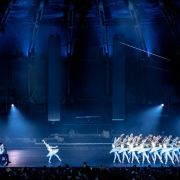
When people think of classical ballet they often imagine Swan Lake, the tale of Prince Siegfried who falls in love with a Swan (Odette), ultimately ending in tragedy. The role of Odette is one of the most iconic roles a principal dancer can portray, and for many girls, who were plentiful in the audience in the matinée I saw, Odette is a symbol of classical ballet itself and a gateway to a lifelong love affair with the art form.

I don't think there’s a major ballet company in the world that does not have their own version of Swan Lake, based heavily on the original choreography by Marius Petipa and Lev Ivanov, with music composed by Tchaikovsky. Created for Dutch National Ballet in 1988, Rudi van Dantzig’s Swan Lake has amplified certain aspects of the original, resulting in displays of dance excellence within a cumbersome narrative.
Principal dancers Timothy van Poucke as Siegfried and Salome Leverashvili portraying Odette approached their roles with mastery and control. Leverashvili is so self-assured and captivating, her Odette is incredibly polished for someone at the start of a hopefully very long career.


Leverashvili is blessed with beautifully arched feet and strong toes that make her pointe work so well articulated and satisfying to watch. The clarity in her port de bras complemented her beautiful extensions as the Swan. Van Poucke is just as dazzling and technically proficient as Leverashvili, breezing through quadruple pirouettes (to the left!) and bouyant double tours en l’air that landed cleanly in fifth in time with the music. Both dancers started in the Junior Company ten years ago so to see them flourish through the ranks is a testament to the company’s investment in their artists.

There are ballet companies that have taken liberties to streamline the story by eliminating characters to heighten the tragic tension between Siegfried and Odette. Van Dantzig’s version retains a variation of the original characters resulting in the story’s strong focus on the male relationships. In van Dantzig’s production it’s Siegfried’s close friend Alexander, danced with a warm exuberance by Joseph Massarelli, who’s most concerned with Siegfried’s brooding behaviour. Alexander’s presence is infused throughout the ballet often dancing by Siegfried’s side. Siegfried may be enamoured of Odette, but it is his relationship with Alexander that he relies on the most.

There are other prominent male figures in this production, notably Von Rothbart, the sorcerer who has imprisoned Odette, danced brilliantly by Robin Park and Von Rasposen, a shady advisor to Siegfried’s mother, the Queen, who has his own two male minions under his wing (portrayed to sinister perfection by Casey Herd). Even the production seemed entirely dedicated to Tchaikovsky himself, whose image was projected onto a scrim in lieu of a red curtain which opened each new act of the ballet.


Inundated by so many male characters, particularly Alexander, I felt as though the role of Odette took on a different dimension. Here she became less of a tragic figure to empathise with and more a symbol of classical perfection and an unattainable vision of love. While this interpretation is perhaps more faithful to the original in some respect, I found myself more touched by the relationship between Alexander and Siegfried than Siegfried’s idealisation of Odette. Even in the final scene before the curtain drops, it is Alexander who is takes centre stage, cradling Siegfried in his arms. Has the ballet been about Alexander’s bond with Siegfried all along?

There were some high points in the matinée, especially in the dancing from the women. Nina Tonoli and Chloë Réveillon sparkled in their solos in the Pas de Trois in the first act, and the Cygnets were right on the money with their precise footwork. Kiri Hilli was a commanding force in the Hungarian Dance. As for the men, two honourable mentions go to Vsevolod Maeivskyi who performed a robust solo in the third act’s Pas de Six and Jenson Blight as a spritely figure in the Neapolitan Dance. As Odile, Leverashvili attacked her 32 fouettés fearlessly adding double pirouettes into the mix. The Dutch National Ballet Orchestra sounded sublime under the spirited conductorship of Fayçal Karoui.
In some ways, one could argue that van Dantzig’s production is well-proportioned, with much of the dancing performed by the women while the narrative is centred around men with Siegfried at its apex. Considering this version premiered in 1988, I do respect van Dantzig’s bold choices even if, in 2026, I’m not entirely sold on the premise.