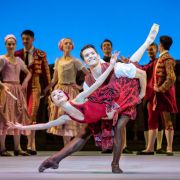
Almost exactly 20 years ago, I travelled to the Mayflower Theatre in Southampton to see the unveiling of English National Ballet’s then new production of The Sleeping Beauty. With pretty sets by Peter Farmer and sumptuous costumes by Nicholas Georgiadis, the staging was based on the production Kenneth MacMillan had originally created for American Ballet Theatre in 1987.

Whilst adding a few new dances of his own, MacMillan retained much of Marius Petipa’s original, glorious choreography, and he did not skimp on the recreation of the innate grandeur of a ballet that had been made for the enjoyment of the Tsar and the Imperial Russian court. Running nearly three hours in duration, the production was not only a technical and artistic challenge for the dancers, but a marvellous, theatrical and highly enjoyable presentation of one of the greatest of all classical ballets. The ravishing music, of course, is by Tchaikovsky.


Returning to the same theatre two decades later for a matinée performance of the same production by English National Ballet (ENB), I was saddened, and a little dismayed, to observe how large sections of The Sleeping Beauty have now been cut. The staging has been shortened by over 30 minutes in order – to quote ENB’s artistic director, Aaron S. Watkin – “to make it more accessible for today’s audience”.
Really? Do audiences of today really lack the concentration span to watch a ballet that is no longer than, say, a play by Shakespeare or an opera by Verdi? I find that hard to believe. Moreover, I would suggest that such cuts show a disregard for a superb ballet which was carefully planned and prepared by both Petipa and Tchaikovsky and that, in turn, was honoured by MacMillan.

For the record, not only has the formal entrance of the Fairies in the Prologue and the dance for Red Riding Hood and the Wolf in the last act been deleted, but the whole of the “knitting ladies” episode at the start of Act 1 (one of the dramatic high points of the ballet) has now gone, as well as almost the entire Hunting Scene at the start of Act 2. I’m particularly disappointed at the removal of the latter because not only does the scene beautifully illustrate, through choreography, music and design, the passing in time of 100 years, but also the magical transition from the real world of the Prince and his hunting party to the fantastical realm of the Lilac Fairy and her enticing vision of the sleeping Princess Aurora surrounded by Nymphs.
Perhaps classical dancing at the very highest level could have helped to dissipate my dissatisfaction with what has been done to the production, but I found the general standard of both ENB’s corps de ballet and soloists to be unexceptional. There were, however, some performances that afternoon I did admire.
Ivana Bueno, in only her third attempt at the role of Princess Aurora, danced with brightness, neatness, clarity and musicality throughout the afternoon. She has strength of technique to maintain the firmly held balances in Act 1’s treacherous Rose Adagio and she brings a wonderful sense of “lift” to her jumps, but she is, as yet, rather a demure Princess. With time and more experience, Bueno will surely convey a greater sense of variety, grandeur and authority in her dancing, which it currently lacks.


Although she had some difficulties with her tricky Prologue solo, Taela Graff’s Lilac Fairy was gracious and benevolent, and I was impressed, too, by the dancing of Chloe Keneally and Hatice Çağla Ertürk in their Prologue Fairy solos and Precious Adams in her Act 3 “Diamond” solo. Elvis Nudo made a handsome Prince Désiré, although he was taxed by his big solo in the Act 3 “Wedding” pas de deux. The best male dancing of the afternoon came from Thiago Silva, who made an impressive debut as the Blue Bird. Full of stamina, his buoyant jumps were high and cleanly etched; if Silva could only point his feet a little more strongly, he could stand comparison with the very best.
The most convincing performance, however, was that of Junor Souza as the wicked fairy Carabosse. Imposing, imperious and quivering with suppressed anger, Souza made a tremendous entrance in the Prologue and I enjoyed the barely disguised disdain Carabosse showed towards her fellow Fairies. It was an exciting account of a role that is sometimes difficult for a man to make convincingly feminine, and Souza was helped immensely by the focused and vivid conducting of the music by Dominic Grier.
ENB will bring this production of The Sleeping Beauty to London’s Royal Albert Hall next summer, where it runs from 25th to 28th June. In the meantime, I hope the company and its artistic director, may have a chance to reconsider the unfortunate musical and choreographic cuts that have marred this present revival.