The music of Parsifal is up there with the all-time greats, but its story and ideas are abhorrent – even the Royal Opera programme describes them as “questionable” and “problematic”. How to present such a piece? The answer in Evgeny Titov’s new production would appear to be “less is more”: don’t mess with the story, don’t add your own opinions, just give the audience enough visual material to keep them interested, make them believe in the emotions of the characters and leave the rest to the music and its magic.

Given the performance of Jakub Hrůša and the Royal Opera Orchestra last night, it was a winning strategy. The orchestral textures covered us in wave after wave of comfort-giving sound, constantly ebbing, flowing, shifting, each wave new and familiar at the same time. String ensemble was perfection, horns and brass refulgent while still precise. You can’t get the full blended sound effect of the sunken Bayreuth pit at Covent Garden, but after some early nervousness, the orchestra came close. Hrůša exerted millimetre dynamic control, both on the shape of individual phrases and on the longer arcs. Time and again, any concern of “do I really like what all this means” was simply washed away by wonderment at Wagner’s music.

We were in low voice heaven. Despite not being the title role, Gurnemanz owns this opera and Brindley Sherratt gave us a Gurnemanz for the history books – authoritative, melodious or hard-hitting as needed, a complete mastery of the role. Every German word was delightfully clear – which was the case for virtually all of the singers, a rare achievement these days. We know that Christian Gerhaher has glorious timbre, intonation and clarity, but his Amfortas also showed a depth of anguish far greater than anything I’ve heard from him. James Platt was a massive voice as Titurel, not quite credible as an enfeebled monarch, but thrilling to listen to none the less.The title role can be sung by heldentenors with a dark baritonal edge, but not here. Stanislas de Barbeyrac was youthful, bright-eyed and bright-voiced, never lacking in power, always contrasting with the pain that surrounds him.

In Act 2, Ekaterina Gubanova and Mark Stone showed exception vocal acting, their mental duel riveting. Gubanova’s interpretation of Kundry was often painful to watch, her nature as free spirit very much taking second place to the fact that this woman is abused by everyone, from the knights to Klingsor to a vengeful deity. Stone’s Klingsor was a classic braggart and bully, strutting and revelling in his own power.
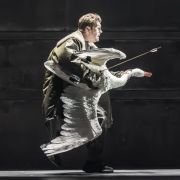
Titov, set designer Étienne Pluss and costume designer Esther Bialas place the opera in a time and place which is modernish but unspecific. Their Monsalvat is a truly miserable place – grey, blocky, militaristic, the watchmen seeing the landscape through CCTV screens – by Act 3, it has become truly decrepit. No weapons are carried which might give a more precise era, except the three in the libretto – the Spear, Parsifal’s bow (its arrow gruesomely in a lifelike swan, still in its death throes) and Sir Ferris’ sword that Parsifal carries. We never see the Grail. Amfortas is a Christ-like figure and the knights fill their cups with blood from his wound.

Klingsor’s garden is a disturbing illusion on a steampunk-style video wall. Initially, it displays animated versions of Renaissance religious paintings; this shifts to multiple clips of Otto Pichler in the guise of “Mama Flower”, a ghastly version of the Flower Maidens. These start (particularly unsettlingly) as a set of child ballerinas, but then become adult in costumes that are a sexualised hybrid of Star Trek and The Handmaid’s Tale – there is then something of both Busby Berkeley and Bottom in A Midsummer Night’s Dream when they remove most of Parsfal’s clothing and place one of their large-eared headdresses on him.
So far, so dystopic, but it’s in the Personenregie that Titov really shines. One of many outstanding moments is in Act 3 when Parsifal arrives and Gurnemanz demands repeatedly that he uncover his face and drop his weapon, the buildup of tension becomes almost unbearable.

Is there real redemption here? Does redemption even have any value when faced with a God who submits Amfortas to unsurmountable temptation and then mercilessly torments both him and Kundry without regard to the repentance of either? My instinct says no, the music says yes. Titov lets you decide for yourself, except for one change. In the end, when Amfortas is to be released from his suffering, there is only one way out, and Titov takes it.
This production is suffused with signs of Barrie Kosky’s influence, Pichler being better known as the choreographer of many Kosky productions. But Titov is also showing a new, independent voice and the musical performance is outstanding. If you love Parsifal, this is a must-see. If you don’t, this might just be the one to convert you.