This is a story about how the dead continue to shape and sustain our present, and how their memory persists through forms that can seem almost magical. Created in 1999 for Les Ballets de Monte-Carlo, Jean-Christophe Maillot’s Cendrillon belongs to that late-20th century moment when narrative ballet was moving away from decorative spectacle and codified storytelling, and being reimagined through a psychological lens.

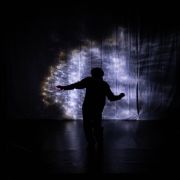
The curtain rises on a scenography of towering book pages spread across the stage, conceived by Ernest Pignon-Ernest, Maillot’s long-time collaborator. Cendrillon’s father dances tenderly with his wife, embodying their mutual love and domestic harmony. This idyllic moment is abruptly shattered by her sudden death, marked by a shower of golden glitter descending from above. These luminous particles return throughout the ballet, marking the connection between the living and the dead, as well as its central symbolic and emotional turning points.
Cendrillon stands in a corner, as if reawakening the image of her mother in memory or fantasy, perhaps even in her subconscious, if we allow ourselves a psychoanalytic vocabulary, in what feels unmistakably like a Freudian ballet. The mourning scene between Cendrillon (Lou Beyne) and her father (Jaeyong An) is deeply moving; their grief is tangible. The mother’s white vest appears in Cendrillon’s hands and becomes a fetish object, a physical relic that recalls her presence and offers support, strength and hope.


Beyne masterfully embodies a luminous character, conveying not only fragility but also a form of dignified resignation. Cendrillon is defined here in an intriguing way: she is not characterised by passive sadness or dreamy escapism, but appears as a genuinely strong woman, aware of her own desires. Her maturation unfolds as a process of emancipation from a dysfunctional family dynamic, a trajectory that feels strikingly contemporary and invites the viewer’s recognition and empathy.
When the stepsisters (Kathryn McDonald and Ashley Krauhaus) and the stepmother (Mimosa Koike) enter, each portrayed with remarkable artistry and conviction, it becomes clear that we are far from the usual schematic or caricatured portrayals of these figures. They are calculating and seductive, using their sexuality and physical presence to bend the father’s will and draw him to their side.

Another choice that calls for contemporary recognition is the Mannequins scene, conceived as an enactment of distortion. Here caricature becomes a theatrical device: three men en travesti as the stepmother and stepsisters, alongside a grotesque rendition of the father, perform exaggerated counterparts of the ‘real’ figures. This theatre within a theatre device sets their rigid, robotic vanity against Cendrillon’s natural, barefoot simplicity.
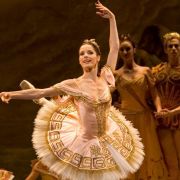
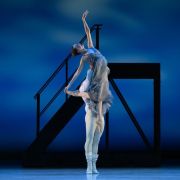
The true centre of the ballet and its propulsive narrative force is the Fairy, the magical alter ego of the dead mother, played with extraordinary radiance and lightness by Marianna Barabas. She dances with such grace and elegance that she seems as though she might take flight at any moment. A force of moral clarity within the drama, the Fairy reprimands cruelty and guides Cendrillon, gently orchestrating her encounter with the Prince. Her magical influence becomes evident in Cendrillon’s transformation, when her bare foot turns to gold, echoing the rain of glitter that opened the ballet. Those feet become an objective correlative of the mother’s presence and the most charged site of desire in the drama.

The masculine world surrounding the Prince, here portrayed with charm and impeccable precision by Jacopo Bellussi, is equally well articulated. We see the court, his companions and the joyful brotherhood that sustains him, encouraging and guiding him toward love. The Prince, too, undergoes a process of growth: before meeting Cendrillon, he appears as an immature young man in pursuit of fleeting pleasures. When the two are finally reunited, they share a deeply moving pas de deux, followed by a slow, tender waltz as a rain of golden glitter once again falls upon them, sealing the moment as the curtain falls.

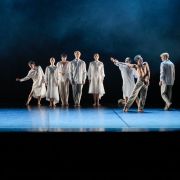
Particular praise must go to the dancers of Les Ballets de Monte-Carlo for their commitment, technical precision and fidelity to their roles. Beyond the soloists’ standout performances, each dancer brings discipline and emotional nuance to Maillot’s demanding choreography. Maillot’s choreographic language unfolds like an unspoken romance: one scarcely perceives the steps as discrete elements; they dissolve into the dramatic whole, into the web of relationships between the characters, into the physical expression of their inner lives. It is a deeply narrative language that seems to breathe with Prokofiev’s score until music and movement become inseparable. Intimate, psychological and subtle, the ballet retains a remarkable fluidity.

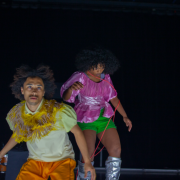
Yet certain aspects reveal the passing of time, reminding us how much our sensibility has shifted since the late nineteen nineties. In particular, the ‘Exotiques’ scene, set to inserted music from Prokofiev’s Lieutenant Kijé, projects a stereotyped vision of femininity. The reddened and yellowed faces evoke the trope of the exotic and dangerous woman, a representation that today inevitably raises questions.
Equally troubling is the gesture near the end in which the father symbolically hands Cendrillon to the Prince, echoing the patriarchal dynamic that Ibsen exposed in A Doll’s House. Even the Prince’s violent impulse, when he attempts to strangle the stepmother with the white vest after the mother’s spectral return, introduces a disturbing note.
And perhaps it is precisely this tension that keeps the ballet alive. Like the mother’s ghost, it refuses to remain safely in the past, continuing instead to shape and unsettle our present gaze.