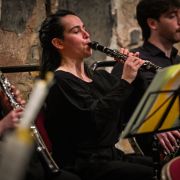
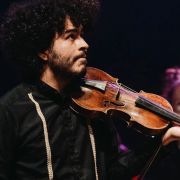
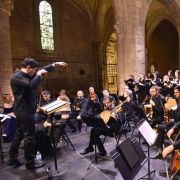
In this article series, together with Sustainable EEEMERGING and its partners, we explore Early music across Europe – and the challenges faced by young artists in various countries across the continent. What is the condition of Early music today?
This article was supported by Festival Kvarner.
In 1667, a devastating earthquake hit Dubrovnik. As a meeting point between East and West, on the boundaries of the Ottoman Empire, Renaissance Dubrovnik was a thriving cultural centre and a wealthy maritime power in its own right. The earthquake left the city devastated, at least 3,000 dead, with buildings destroyed and swathes of culture lost – including manuscripts in the collections of monasteries and private houses. It is a cultural loss still being felt to this day, especially amongst performers of historical music.

Surviving music by composers from Croatia written before the 17th century is largely that which was preserved outside of the country. And ironically, reliance on a wider career in Europe remains something important for many Croatian musicians today. “What they need is the connection to the rest of Europe,” says Michael Fendre, leader of Festival Kvarner, in the coastal resort of Opatija, which has in recent years taken to specialising in platforming younger musicians in Early music. “If they’re accepted in the rest of Europe, they will also be accepted in Croatia.”
Since the 1990s, when Croatia underwent fierce separation from the other states of the former Yugoslavia, the situation for musicians has often been difficult. The formation of the Croatian Baroque Orchestra in 1999 marked an important moment for the Early music movement in the country. But with limited budgets for music from the Ministry of Culture, musicians are often fighting over a smaller territory.
Nevertheless, the pedigree of Opatija, where Festival Kvarner has based itself for the past 16 years, is enviable. The riviera has boasted real cultural capital, especially in the early 20th century. “Gustav Mahler composed there, Puccini was there,” Fendre says. “Opatija had the first operetta festival in the world, and has its own operetta hall, a concert hall for 1000 people, and an open-air stage for 5000 people. The infrastructure is beyond the imagination, fantastic – and on the seaside! During the monarchy, there was a tradition that twice a day they would have classical concerts.”


Fendre and the festival have been instrumental in establishing a new group, Gli Schiavoni, of young Croatian musicians looking to capture the current interdisciplinary trends of the Early music world. With a rich balance of continuo and soloists, the ensemble aims for adventurousness and flexibility in repertoire and arrangement, an interest in traditional music of the region, as well as trying to recover Baroque music of Croatian composers themselves. “We decided on the name Schiavoni,” says soprano Antonija Žarković, “which historically refers to the people living on the coastline of current-day Croatia. We decided we would focus on our heritage, which needs to be researched, and there is a huge need for recordings which are historically informed.”
And it truly is a musically fascinating corner of Europe. The Istrian peninsula is home to a unique form of traditional music, with its own instrumentation, scale and harmonic structure. This year, Gli Schiavoni are working on arrangements of traditional Istrian repertoire for Baroque instrumentation. “To someone who is not accustomed to it, it sounds very ‘interesting’!” Žarković says. “Singers also emulate the sounds of shawms and flutes when they sing.” Traditional music of the northern part of the country is also close to Hungarian styles: “rhythms very much sound like Hungarian music, but also not – it also sounds Slavic. Though it’s a small country, it’s very diverse in its cultural heritage,” Žarković adds.

Despite the perennial problems with documentary survival – and a repeated series of earthquakes – Žarković and Gli Schiavoni are determined to mine what they can from the archives. “Things got lost, things got burned, things got stolen,” Žarković says. “It’s frustrating because we know there were Croatian operas, possibly four or five, written in the 18th century. It’s extremely frustrating when you know the name of the librettist, you know the name of the opera, you even know the name of the person who composed it, but you cannot find the score.” Nevertheless, Žarković is frequently digging out Croatian Baroque material in Latin and Italian. And she has her eye on the archives of the Franciscan friary of the Little Brothers in Dubrovnik. “They have a lot of manuscripts!”
Among the surviving documents at the friary archive are works by Elena Pozza-Sorgo (1784–1865), the first female Croatian composer whose music survives. While most vocal pieces are in Latin and Italian, Žarković suspects there may be a song in the Croatian language. “It would be very interesting to retrieve… I’m on a mission!” Sorgo hailed from the aristocratic Sorkočević clan, which included several other composers of the pre-Classical era, including Luka and son Antun, who both wrote symphonies and chamber music, the latter becoming Dubrovnik’s mayor.

In performances this year, as well as performing Croatian and Italian Baroque, Gli Schiavoni are uncovering music by the rather un-Croatian-sounding Francesco Usper (or Sponga), born in Istria in the 16th century. Making a career in Venice, he studied with Andrea Gabrieli and later collaborated with Monteverdi on a requiem mass (now sadly lost). However, a good quantity of his music does survive, including instrumental sinfonias in the Venetian style, and vocal music.
I ask Žarković about the distinctive characteristics of singing in the Croatian language. “We obviously have a lot of consonants, but somehow it’s more open than other Slavic languages. It has the most open vocals – we have only I, E, A, O.” Žarković recalls a recent vocal project with Gli Schiavoni: “I had the idea to look at St Barbara’s lullaby,” a traditional lullaby poem in Croatian. “Anything to do with certain female saints always piques my interest. But as I dug deeper, I realised that we have the text but not the melody. I reached out to people in the region where the song originated, but they didn’t know the melody either. You might simply have a grandma who died, and the song died with her. But then we thought, it’s a beautiful poem, we can maybe combine it with something else. We started finding tunes from the Baroque and Renaissance periods, and then began blending the two together.”


Taking a flexible and creative approach to small group performance, with influence from traditional music-making, is a hallmark of the latest developments in historically informed performance, well represented by Gli Schiavoni. The distinctive vocal traditions of Croatia are also of profound interest to Žarković, too. “Choral work, if we’re speaking generally, it’s something that is cherished, but I don’t think we have such a big tradition compared to, say, Latvia or Estonia.” But the distinctive Glagolitic singing, especially of the Kvarner gulf and Istrian peninsula, is especially unique.
In the Old Slavonic language, “it’s sung with a specific type of tuning,” Žarković says, “the distances between notes are even smaller than a half-step, ie, quarter-tones.” Croatian musicologist Katarina Livljanić, who runs vocal ensemble Dialogos, has been instrumental in preserving aspects of this continuing tradition. “The villages are getting smaller and smaller in population. And it depends on younger generations whether they are interested or not – unfortunately, I have the sense that they are not,” Žarković says.
Nevertheless, the distinctive music of Istria continues to inform Žarković’s singing, thanks in part to her mother’s family, who come from the region. When Gli Schiavoni decided to perform traditional Istrian material, “I was more accustomed to the sound than other members of the ensemble,” she says.
In the meantime, Žarković and Gli Schiavoni continue to perform in the wider region, including in Zagreb and Pavia. They also took their blend of historically informed performance to a cardiology ward – a personally important thing for Žarković, who has been combining a career as a performer with one in music therapy. “For me, balancing both things, I realised it’s the best of both worlds… When you’re financially stable, you can start focusing on what you actually want to do, what you actually want to perform,” she says.

Michael Fendre is also keen for young musicians to obtain financial stability, including Croatians, which has been at least part of the reason for the partnership between EEEMERGING and Festival Kvarner. And also nascent is an ongoing project to create a new large ensemble of Early music performance, bringing together musicians from across former Yugoslavia, including Slovenia, Croatia, Serbia and Bosnia. “To collect all these musicians, the good ones, across this region… sooner or later, it has to happen.” Amen!
Sustainable EEEMERGING is funded by the European Union.
Views and opinions expressed are however those of the author(s) only and do not necessarily reflect those of the European Union. Neither the European Union nor the granting authority can be held responsible for them.
This article was sponsored by Centre culturel de rencontre d’Ambronay.