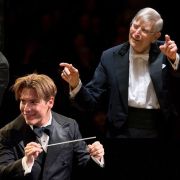
With a track record in exploring lesser-known works, it’s a safe bet that Sir Mark Elder will have something unusual in his diary at any given time. Two performances of Bizet’s complete incidental music for L'Arlésienne by the Orchestra of the Age of Enlightenment at the Queen Elizabeth Hall in a new staging are typical of Elder’s pervasive curiosity.

It was in July 1872 that Bizet attended a reading of Alphone Daudet’s play about the tragic impact a girl from the French city of Arles had on a small agricultural community. Two months later, the play received an unexpected premiere with music that Bizet composed in the space of weeks. It was a flop: a rushed production, under-rehearsed, proving fatal. Bizet’s music seems to have provided some of the rare positive criticism, prompting him to write the first of two suites which have become some of his best-known music.


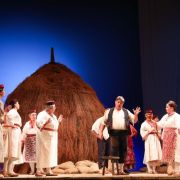
The play itself lived on in operatic form through Francesco Cilea’s L'arlesiana and it does feel naturally veristic, as Jeremy Sams’ new production for the QEH demonstrates. He relocates the action to a Yorkshire village, rugged and tough, where hardship and death are constant companions, and everyone has their own heartbreak. A caravan on the left, a washing-line on the right and some furniture in the middle, next to a small shrine to the Virgin Mary, make up the set at the front of the stage, with Elder and his reduced forces – the score is for just 26 players – at the rear.

The play itself is fairly simple. There is a village family consisting of a grandfather, Francet, his daughter-in-law, Rose, and her two children, Frédéri and a rather unworldly younger brother, Pierre, known predominantly as The Kid. Their shepherd, Balthazar, is a close friend of Francet and acts as a sort of family uncle. Vivette, Rose’s goddaughter, has loved Frédéri since childhood, but he has fallen in love with the eponymous girl from Arles. We never see this character, but her presence is constant in the heartbreak of Frédéri and the resulting gloom that pervades his family. As the play opens, the girl has agreed to marry Frédéri, but celebrations are quickly halted by the arrival of Mitifio, a rival lover, who brings love letters as proof of their affair. After a brief engagement to Vivette on the rebound, Frédéri kills himself by autodefenstration.

It’s a difficult play to like; Frédéri, an energetic if slightly overacting Kerill Kelly, comes across as a wet blanket, while his family seems perfectly content to sacrifice Vivette’s happiness in an attempt to stir him out of his funk. Pierre, an engaging and slightly unwordly Otto Lenssen, is ignored, drawing affection from Balthazar until Rose finally realises her neglect. Indeed, if Vivette is the heart of the play – Mercedes Assad gives us a character of innocence and goodness, deftly displaying how unrequited love can be buried under a perpetual bustling – Balthazar is the play’s conscience. His reunion with an old love in the final act is touching, the one positive in an otherwise bleak conclusion. Finbar Lynch’s assumption of the role was splendid: bleak-toned, but warm beneath the cragginess, there was consistent nuance in his delivery. Helena Lymbery was a trifle flat in her delivery of Rose in the first act, but then hers is a flat character – Lymbery's Rose is dungareed and perpertually in motion, acting as mother, father, businesswoman. The descent of her eldest was traced in the deepening anxiety written across Lymbery’s face as we paced towards the denoeument. Simon Slater’s bluff Francet – clinging to old values – was at his best in Act 2 in a terrific scene with Lymbery. Richard Riddell made an unpleasant, bitter Mitifio, with little to redeem the character.


And then the music! Elder made a compelling case for the score with a lush and verdant reading, luxuriating in the slower parts, but with plenty of impetus where needed. The OAE’s string attack was unified and brisk, and there were a couple of glorious moments of pizzicato for the lower strings. The woodwinds brought out that particular Bizet-like fragrance and the horns were consistently excellent. As a combined work, it’s never going to take off, but Elder and Sams made it a rewarding theatrical experience.