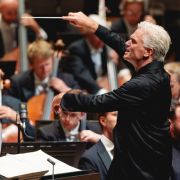
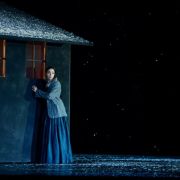
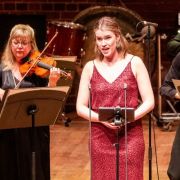
This first night of this production by William Kentridge was the also the first ever performance of Monteverdi’s L'Orfeo at the Glyndebourne Festival, surprising for an intimate work ideally suited to this house. Indeed it might well have been given its Mantuan premiere in a room not much bigger than Glyndebourne’s organ room. But there few nods here to the authenticity of the historical recreative kind, except from the pit. That was occupied by the Orchestra of the Age of Enlightenment, playing superbly under conductor Jonathan Cohen. They were performing a piece from before the European Enlightenment, indeed from the dawn of the 17th century and of opera itself, of which Orfeo is the first great, and thus enduring, example. Monteverdi deployed all the available techniques of his day, raising them to a new level to achieve dramatic coherence over a two-hour span.

What he did not invent was the story. Monteverdi’s friend and fellow Mantuan courtier, Alessandro Striggio, drew on earlier, even recent, Orpheus retellings for his libretto. The unchallenged aesthetic of the day was that the words were paramount, the music there merely as a support. Audiences were even given copies of the text to consult during the performance. The other expectation of the audience was an imposing setting, ideally a breathtaking visual spectacle.


This Orfeo production blended these earlier requirements. We all have the text these days, given to us in the form of surtitles. The music and accurate and expressive singing is more important nowadays and the staging, direction and set design should be on a level unknown to the Court of Mantua. Drawing is central to Kentridge’s work, which he describes as “a way of thinking in time, marked by erasure, movement and revision.” So the setting was an artist’s studio, where an artist (who also sings the role of La Musica) imagines the whole production, creating the images we see projected onto the stage backdrop. These often show the natural world, trees and landscapes, later the Underworld. The artist at her desk moves a brush and we see the strokes projected large-scale, where initial broad brushstrokes develop into trees, which might grow, change then fall (all Kentridge drawings in origin). Text is also sometimes visible, in that some of these images are scrawled across projected book pages, and sometimes readable-sized text is added. At one point, phrases appear from the poetry of Rainer Maria Rilke, inevitably from his great Sonnets to Orpheus of 1922.

Whatever else the Orpheus myth is about, one element is surely creativity, since he invents what he sings. This bold setting certainly reflects that, the artist’s studio being the very scene of the creation of this telling – probably the thousandth retelling – of the most retold myth of early opera (not to mention later operatic versions from Lully to Birtwistle). Kentridge’s invention deserves to stand as a landmark production in all the ways that have been devised of staging this work, and a coup in Glyndebourne’s 2026 season.
As is often the case, the greater the creativity before us the harder we spectators must work. Not all we see projected can be related moment-by-moment to the story or the stage action, unless we are very alert, and indeed, creative ourselves. In fact the challenge to the audience is to shift its gaze from swift-changing back-projections, up to the changing surtitles, and then right down to the characters on stage, somehow keeping the focus on the relationship of all three.


The singers formed a strong team. Each sounded well versed in the singing of monody, even those tricky rapidly repeated notes that would later be replaced by trills. The Orpheus of Krystian Adam, in voice and movement, made a splendid attempt at portraying the finest singer the world has ever heard, even if one unable to persuade the Styx’s gatekeeper, the immovable Charon of Callum Thorpe. Davide Giangregorio sang a sonorous Pluto and Caspar Singh, an impressively sung golden-jacketed Apollo, drew his son Orpheus up to heaven at the close. Fine countertenor Kieron-Connor Valentine was an eloquent Spirit and Shepherd.

The women were very consistent. Francesca Aspromonte began things well with a sweet-toned La Musica, and sang the few lines given to the mostly absent Euridice, a role mostly here taken by a dancer (Roseline Wilkens, choreography by Gregory Maqoma). As Proserpina, Leia Lensing maintained the good work. But the Messenger, who in Greek plays often arrives to spoil things with news of an offstage catastrophe, announces the death of Euridice. But while somewhat spoiling the nuptial celebrations, this unrepentant Messenger, Xenia Puskarz Thomas, snatched the opportunity to deliver the best singing of the night.