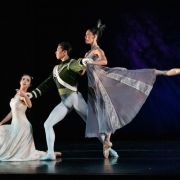
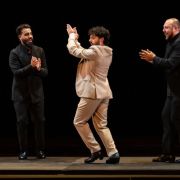
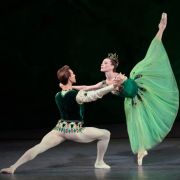
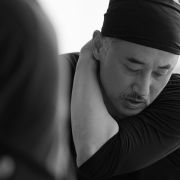
When the young dancers from LaGuardia High School of Music & Art and Performing Arts kicked off the final night of the Battery Dance Festival, a portal opened in the leaden grey sky: optimistic robin’s-egg blue edged by lemon-yellow clouds that rolled back like cotton candy. The jagged impulses of Roderick George’s The Cosmic Law ran through the ensemble like an electric current – one of many works over the six-day festival born of an irreproducible alchemy of movement, music and setting.

Closing the festival, Sidra Bell’s Grounds for Battery Dance Company unleashed its quiet terrors, reinforced by the gathering darkness and hard glittering lights outlining the Statue of Liberty, the massive ship-to-shore cranes behind her and the Jersey City skyline to her east. Shiny black asymmetric Norma Kamali outfits gave way to skintight BADINKA catsuits etched with fluorescent topographies. Against an ominous soundscape, the dancers pressed together into a hill, a bulwark – reminding us, perched on the terraced slope of the newly reconstructed park, of the floodwalls buried beneath us, shoring up lower Manhattan against increasingly damaging storms. Soon the choreographed hill crumbled. The score suggested an emergency as much as the dance conveyed wariness and resilience.

Another score sounded an emergency in Nat Wilson’s someone has to leave first. Composer Paul Jebanasam fused the hammering of distant gunfire, the pounding of waves against a seawall, radio static and waves of shimmering strings into something beautiful and engrossing, that swept Wilson and Grace Whitworth up in its mesmerizing undertow. Their partnership was quietly thrilling, full of unconventional lifts that wrapped and unwrapped, movements that threatened to combust but instead dissolved. In khaki T’s and slouchy trousers, they eyed each other with distrust as a military copter whirred overhead.


Zakhele (Bboy Swazi) Grabowski navigated a solitary path through a thicket of tap dancers in Jessee Leigh Robinson’s For Whom the Bell Tolls as J. Cole and Kendrick Lamar rapped of dread and isolation. The possibility of connection was evoked in a spellbinding encounter between the gravity-defying b-boy and tapper Audrey Chapin, both claiming and ceding space on the floor against a backdrop of choppy waters in the deepening dusk.

Dance forms also collided in Soles of Duende’s exhilarating The Kitchen, in which the percussive trio of Amanda Castro, Arielle Rosales and Brinda Guha argued amiably over how to cook rice and other profound matters in the languages of tap, flamenco and kathak. Carving different geometries in space, Castro blazed, Rosales simmered, Guha stayed cool, fueled by live trumpet, guitar and drums. They gestured majestically to the Staten Island Ferry in nuclear orange as it glided by, each with her form’s distinctive flourish of the arms.

Four powerful pieces made the stunning backdrop disappear altogether, beaming us into uncanny alternate realities with starkly minimalist devices. Four dancers of Taiwan’s Mailantia Dance Company, bound together by their braids in choreographer Yun-Chi Lai’s Mutual, softly undulated their spines, fluttered their fingers and scooped their arms before fists flew and arms flung imaginary axes. In the grip of a churning, propulsive score knitting electronica, Chinese instruments and Middle Eastern melodies, they shambled, tumbled and wrestled invisible adversaries with extraordinary discipline: a head movement a few centimetres off could have thrown the quartet off balance. Once untethered, they wielded their long braids like weapons or gripped them between their teeth like a horse’s bit. Lai, who danced with Hofesh Schechter’s junior company, folded hints of his slinky, slouchy lope into a thrilling primal language of martial arts, modern dance and street. The exquisite fraughtness of the choreography evoked hair’s politicized history in Taiwan, where successive regimes imposed or banned topknots and braided queues – hair signaling for centuries either submission to authority or resistance.

Resistance was at the heart of Romanian choreographers Camelia Neagoe and Maria-Luiza Dimulescu’s Maybe by 2301, we won’t need another feminist show. The spoken-word soundscape was the main event: a battery of clichés about women (“they must be virgins, mothers… they must work out, not sweat”) and chilling statistics of violence against women, delivered in deadpan rapid-fire. Dimulescu, Mariana Gavriciuc and Anca Stoica riffed on this with mordant gestures, a fashion-show spoof and the outlandish – as when a dancer stuffed fresh eggs under flesh-toned tights, then crushed them one by one while another expounded into a microphone on “the uterus as a common good.” The women kept the rage submerged, leaning on absurdity to sharpen the attack. In the final moments, they brought us back to the tip of Manhattan, turning toward Lady Liberty in the distance with raised fists.

Cía. Elías Aguirre from Madrid wafted us to a magical kingdom deep in a meadow, under the leaves of a tree or in the muddy zone where water meets a riverbank – someplace teeming with butterflies, damselflies and mantises. A setting conjured with great economy by simply crowning choreographer Elías Aguirre, David Candela and Mario González with helmets of flowers. Wearing bemused expressions, they hopped on and off each other, shivered and twitched, investigated things on the ground with arms extended like tentacles or antennae, popped and locked, lurched like drunken cowboys in a saloon, dove to the ground and kicked one leg behind them as if stuck in goo, and made frantic little fluttering gestures – evoking the wonder of exploring a new world and constant vigilance against predators. A celebration of the delicate and ephemeral, Flowerheads reminds us of humanity’s tiny footprint in the universe.


Kathak artist Tanveer Alam spun us into another world in ZIKR, his form occasionally a blur as if preparing to escape earth’s gravity. His arms softly embraced the air, silky hands tracing invisible plumes of smoke. The striking omission of traditional ghungroos (ankle bells) arose from Alam's questioning of what he feels “can sometimes be an unnecessary exotification of the ghungroos as a material and visual signifier of Indian dance.” In ZIKR, the absence of ghungroos shifted focus from Kathak’s percussive sound to its undulant body lines: a stripping away of spectacle, a turn toward something more contemplative. That inwardness broke open in lightning-fast footwork, chakkars (spins), airy leaps and a running slide to the ground. Named after the Sufi devotional practice of remembrance, the dance seemed to emerge from the hypnotic music of singers, musicians and a clapping ensemble who drew their hands out as if spinning yarn, torsos swaying. Alam brought something personal to Kathak’s formal tradition, choosing Sufi songs tied to his Bangladeshi-Canadian heritage – music that reasserts, amid a right-wing push in India to separate Hindu and Muslim cultural heritage, a lineage he sees as inseparable.

Two works drew power from the watery setting – and touched on the monstrous injustice of two historical events that have left little imprint on Western consciousness. SIREN, Mesma Belsaré’s engrossing work for herself and Ramya Shankaran, was provoked by the unprecedented humanitarian crisis of 2020, when the COVID lockdown sent tens of millions of migrant workers trekking on foot from Indian cities to their home villages. Against a backdrop of vessels negotiating the harbor cross-chop, the image of a parent in a blood-red mask cradling an imaginary dead child, while a seraphic figure in gold hovered and skittered, was among the Festival’s most quietly stirring. Yet the restless, episodic work lingered on no single image. Handsome sculptural moves fusing Indian classical and modern dance, sleek costuming and terrifying masks conjured scenes of love and war, the thrilling score punctuated by lines from Tagore (“My heart, like a peacock it dances”) and Kipling (“The Earth is full of anger / The seas are dark with wrath”).

A sliver of moon in a purple sky was visible above New York Harbor in Seyong Kim’s The Moon Reflected in East Sea. This haunting, impressionistic solo paid tribute to a Korean statue honoring the estimated 200,000 women – mostly Korean, but also Chinese, Filipino and Indonesian – forced into sexual slavery by the Imperial Japanese military in World War II. I reported on a performance at last year’s Future Dance Festival by Filipino-American dancer Tiffany Mangulabnan, who illuminated the pathos and dignity of this work, with its precarious balances and quietly dramatic falls and recoveries.

At Battery Dance Festival, casting a white dancer muddied the specific cultural inheritance the role carries. The choice of which body stands in for an absent historical body matters – especially in a work devoted to a still-contested memorial of a particular national and gendered trauma. Kim has made that specificity explicit, from the disputed “East Sea” of the title to the hanbok-inspired costume and elements of traditional Korean dance. A second generation Korean who grew up in Japan suggested that a white dancer performing the work in Korea could offer “a bit of distance to the raw wound of the tragedy for the Korean audience” while signaling that “the Western world is also cognizant and understanding of their pain.” Before a largely Western New York audience, the equation changes. Performed at the water’s edge, under the moon and in sight of the Statue of Liberty, the work might have become a powerfully resonant act of remembrance; its casting instead blurred the history it asks us to remember.