One might imagine a programme of classical music by living composers to be in the minority interest category. The versatile Scottish Chamber Orchestra has been developing its excellent New Dimensions series, growing this strand season by season. This programme of works by Max Richter, Philip Glass and John Adams sold out both Edinburgh’s Usher Hall and Glasgow’s City Halls, the eager crowd spilling over into the choir seats. A packed hall turned a concert into an extraordinary and memorable post-minimalist event.

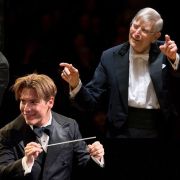
Conductor David Brophy introduced the pieces, played in a continuous sweep in the first half. Richter’s Opus 2020 was commissioned for the 250th anniversary of Beethoven’s birth, the composer taking Stockhausen’s Opus 1970 for multiple radios as inspiration. Here, Richter created a memory piece using Beethoven fragments from his Piano Sonata no. 30, making loops of stretched passages of varying lengths for the players, flattening the orchestra to create an organic soundscape. Brophy beat a slow four, piano, harp and timpani waymarking the piece every 8th beat with a cycle E G# B continuing throughout, the conductor’s willowy figure leaning over the players as he encouraged the different sections to briefly emerge out of the dream. Faint horns called across the evolving landscape before the piece ebbed and flowed into silence. The intensity heightened Michael Bawtree’s lovingly crafted piano Adagio from the Sonata, conductor, orchestra and audience completely motionless as Beethoven’s heartfelt notes struck us all deeply.


Glass’ Company for strings, in four short movements described by their metronomic timings, was written for a string quartet as incidental music for Samuel Beckett’s play of the same name. This version for string orchestra broadened the piece, capturing Beckett’s urgency, as Brophy explained, to address the here and now rather than procrastinate. After a hesitant start, the trademark Glass arpeggios looped and twisted, the players creating arches of sound in a perpetually changing focus. The two slower movements had a delicacy with surprising dissonances, but the final passages were full of grit, flying accents, the strings biting hard in a relentless and exciting mechanical pulse.
Full orchestral forces returned for John Adams The Chairman Dances, an out-take from his opera Nixon In China. Peter Sellars directing the original production had Madame Mao gatecrashing the formal presidential banquet and dancing with Chairman Mao who emerges from his portrait in a surreal sequence to dance a foxtrot to a gramophone record. The chugging rhythms and pings from busy percussion and woodwind sections created Adams’ familiar wash of sound. The strings took up the central filmic foxtrot music with a teasing lilt before the piece built back like a train gathering momentum, the players uniting in a tight joyful sound. Finally, piano gave way to percussion, slowing up to soft sandblock and kick drum as the Maos’ wind-up ran down, the needle stuck in the final groove.
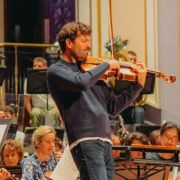
Vivaldi’s Four Seasons is so ubiquitous it is a magnet for reimagining. Piazzolla composed his own, while Anna Meredith’s Anno perhaps mirrors Richter’s approach closest. Norwegian violinist Mari Samuelsen directed the slimmed-down strings, LED vertical strips lit in differing hues, guiding us through the seasons. With miked-up instruments and after an electronic introduction from Chris Ekers, the twelve movements took us on the Recomposed journey, Richter discarding 75% of the material, choosing the passages he liked, looping these with reworkings. Samuelsen drove the piece, playing without a score, communicating with the players closely to control balance and texture then letting rip brilliantly in bursts of infectious high energy. The contrasts of shimmering ethereal upper strings to a boisterous club groove provided a joyous reassessment of the familiar work.