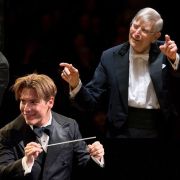
It is genuinely mysterious and comes to us all, but death has inspired many musical works, ranging from solemn memorial through acceptance and resignation to angry defiance. The Royal Scottish National Orchestra with its Principal Guest Conductor Patrick Hahn explored this shadowy world with an intriguing programme of contrasting textures and mood.

Bach composed Komm, süsser Tod for bass soloist with continuo as one of 69 sacred songs, a heart-breaking plea for death to come to end the weariness of the world. Leopold Stokowski adapted it for full orchestra giving the original a deeply expressive sheen, its 1946 premiere tagging it with a post World War 2 elegiac quality. Hahn set a slow steady pace in this short piece, cellos taking the theme wrapped around by hushed strings before it was passed to woodwinds to be taken up in a gentle orchestral swell.


Alfred Schnittke set his own agenda, studying at the Moscow Conservatoire and baffling the Soviet authorities with his juxtaposition of musical styles and experimental works. His 1984-85 Viola Concerto was a late piece, composed for his friend, the outstanding violist Yuri Bashmet. The score calls for full orchestral forces minus violins but the otherworldly additions of harp, celesta, piano and harpsichord, the remaining strings anchored by eight double basses. In three movements of increasing length (slow-fast-slow) Lawrence Power completely inhabited this challenging piece beginning with a hesitant theme encoding Bashmet’s name into the notation.
A soft dissonance grew more lyrical as the work developed, Hahn whipping his players up into rushing winds and arresting moments of rhythmic unison. Power moved from the burnished dark-toned hypnotic to leaping fierce arpeggios, the orchestra forming fragments of a lopsided waltz with a sinister edge. The contrasting textures from unusual instrument combinations provided much interest, flute, clarinet and soloist exchanging phrases, the piano providing quiet decoration and the six percussionists suggesting an almost industrial feel at times with their quiet clanging.
The focus was on the soloist, hardly pausing for the entire work, Power a master of tone and dexterity, especially for the impressive double-stopping with left-hand pizzicato in the cadenza, and I loved his solo with the four trombone chorale. It’s not a cheery work but has an ethereal beauty as themes dissolve into the ether in the final bars. Schnittke described it as a premonition of what was to come, in his case a stroke which sadly curtailed future compositions. As an encore, Power rewarded our concentration with a lovely version of Marin Marais’ Les Voix Humaines in a duet with Principal Cellist Pei-Jee Ng.


Shostakovich had to balance on a knife edge to keep authorities on side, where falling out of favour would have serious consequences. The Soviets wanted uplifting uncomplicated music, and his Lady Macbeth of Mtsensk, and his Fourth Symphony (still under wraps) were neither, so the Fifth Symphony was pivotal. Happily it was cheered to the rafters, but it is a work of protest despite its triumphal ending. Hahn’s precise crisp conducting brought an almost dangerous unpredictable tension to the piece, from the mysterious opening to the visceral violins with bright solos from the flute and oboe. His judge of the second movement rubato kept us guessing, highlighting the satirical. The strings seethed broodily in the largo, Hahn feeding the restless undercurrent, but even in the quieter moments with oboe and filigree firsts and in the harp and flute passages, the players captured the restless energy. The finale was explosive and exultant with heroic brass and incessant brutal slashing in the strings. A disturbing, but under Hahn’s guidance, also a thrilling experience.