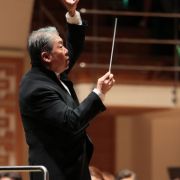
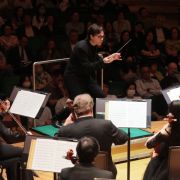
Rarely are two depictions of Pan, the lusty Greek god of the wilderness, and his thwarted pursuits of spirited nymphs found on one concert programme. If that sounds a bit like “it’s all Greek to me”, just imagine an all-Nordic program at the French May Festival in Hong Kong. As random as it was, however, the Hong Kong Sinfonietta and Estonian guest conductor Olari Elts embarked on that journey, successfully juxtaposing a pairing of Pan and Syrinx (Carl Nielsen) and Pan and Echo (Jean Sibelius), each serving as quasi precursors to the Saturday evening’s concerto and symphony.


The evocative, pastoral setting of Nielsen’s Pan and Syrinx was well depicted by the orchestra, enhanced by taut and busy muted strings and a superbly nuanced cor anglais solo from Alex Tsang over the dreamlike tinkles of a glockenspiel. Later, when half-man, half-goat Pan wildly pursues Syrinx before she’s turned into a reed, the swirling clarinets and the string tremolandi made for a furious final chase.
With little fuss, Nielsen’s Clarinet Concerto followed and saw Brittany-born clarinettist Raphaël Sévère (the only French link to this French May Fest) as the ever consummate and centred soloist, even belying the eccentricity of the acrobatic writing. Dazzling with a plethora of mood swings throughout the concerto’s three sections, Sévère unleashed a bevy of colour, silken tones and squawking in the highest registers that was arguably more sophisticated than gritty. With that and the stormy strife in the orchestra, Elts led an energy-packed Allegro vivace which, on its return to the Adagio’s stillness, came as a warm and welcome embrace back in the tonic F.

Whether or not the City Hall technicians were in on the musical shift further north – from Denmark to Finland – the already bracing air-conditioning (which Elts also pointed out in his preceding remarks) was even turned up a notch for the Sibelius. Musically though, more chills followed later on in Sibelius’ setting of Pan and Echo, Dance Intermezzo, when the orchestral dance depicting Echo’s demise took a frantic turn, punctuated by angular winds and string pizzicato that increased in wildness as the musical nymph was torn apart and strewn across the landscape as her parts continued to sing.


Thankfully, the Finnish master’s Third Symphony was free of that brand of drama, and Sibelius’ almost Classical desires, especially in the Allegro moderato, were rendered with buoyancy and enthusiasm by the musicians as they exuded rustic sentiments with economic articulation. Greater presence and earthiness from the cellos and basses would have enhanced that rusticity, but the sways and lilts in the Andantino were delightful. Building terraced, Beethoven-like dynamics as the Allegro increased in intensity, Elts and the in-form Sinfonietta also mastered the ebb and flow of their rubato along the way before reaching a thoroughly rousing finale.