The Great Wave is a truly worldwide image, the famous wash of Prussian blue violent surf, its undertow threatening to engulf tiny long rowing boats framing Mount Fuji in the distance. On t-shirts, key rings, banknotes, in the new Japanese passports... and now it’s an opera. Composer Dai Fujikura and librettist Harry Ross introduce us to the extraordinary artist Katsushika Hokusai and his daughter Ōi through a series of vignettes seen mostly in flashback. Director Satoshi Miyagi has brought his entire creative team from Japan for this exciting world premiere at Scottish Opera.

Hokusai produced some 30,000 images in his 90 years, survived being struck by lightning and the setback of a studio fire in which several of his, and his daughter’s, works were lost, yet created his most famous work when he was 70. He moved house many times in Edo (now Tokyo) and went through as many name changes before moving to Obuse to escape government crackdowns and censorship, an eight day hike north of the city, two hours by bullet train today. In an era when Japan was a closed country, the Dutch, who bravely attempted international trade, would change the artist’s life and fortune.


Fujikura and Ross create a challenging five act timeline for audiences to follow, beginning in complete silence as a series of black clad figures place single blooms on Hokusai’s grave, Ōi remembering her father as her “North Star” as his spirit hovers behind. We flashback several decades to see Hokusai struck by lightning in a paddy field, seeing a vision of a wave and fast fishing barges in his delirious state, a white-clad chorus of rowers brandishing their oars. The funeral arrangements continue meanwhile, friends paying tribute and Mr Tozaki handing round sweets from his shop, Ōi proclaiming that Hokusai wanted another ten years of life to enable him to become a true artist.

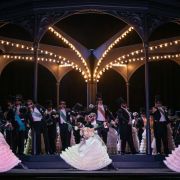
Back several years, Hokusai needs money and produces a huge cartoon image of Bodhidharma as performance art with buckets of paint, the image hoisted up for the crowd. Yohachi, a publisher suggests he sell images to the Dutch, an illegal trade, the onlookers even asking if the “Dutch are like us and whether they eat babies”. Yohachi meets Dr Philipp Franz von Siebold, who gives him no money but a pot of Prussian Blue pigment. Meanwhile, angry creditors turn up threatening to collect debts in flesh if not coin, but the pigment arrives in the nick of time, Hokusai recognising the artistic and Ōi, the financial possibilities and The Great Wave is painted. In a big first half finish, costumes shift from monochrome to colour and the scenery pulls back to reveal the splendour of the famous image.
The final acts deal with later life, another extended silence as Ōi brews yuzu tea for her frail father as merchant patron Takai Kōzan, suggests moving to Obuse to allow more artistic freedom. Children queue up asking for animal drawings, Hokusai explaining that small images can be simple and noble. A final cluttered dream sequence sees a tiger and dragon rising from the page and circling the artist without menace as he urges his daughter, “a better artist”, to continue as a new North Star, brush in hand as we finally circle back to the opera’s beginnings.


The Great Wave is an ambitious endeavour to encapsulate Hokusai’s long life, but is burdened by dense detail, libretto longueurs and a wandering timeline. Costumes from Kayo Takahashi Deschene are a beguiling blend of period and futuristic with touches of origami and calligraphy, each outfit beautifully detailed. Dressing everyone in similar-but-different white outfits is challenging at auditorium distance, but as colours emerge, it becomes a smart look. Junpei Kiz scenic unfolding cylindrical designs are simple and effective with Yuka Hisamatsu’s lighting adding drama.

Chorus director Suzannah Wapshott can be proud of the extensive chorus work, including children, who all sounded excellent, adding substantially to the action. A troupe of actors/dancers with choreography for all from Akiko Kitamura added welcome visual energy. The singing was very fine, especially baritone Daisuke Ohyma and soprano Julieth Lozano Rolong as the two main roles and rich bass Edward Hawkins and lyric tenor Shengzhi Ren on double role duty. Dutch trader Colin Shay’s measured countertenor was deliberately other-worldly. Conductor Stuart Stratford navigated Fujikura’s filmic score, the orchestra producing wonderful sounds including mystical string chords, drumming and featuring shakuhachi flute player Shozan Hasegawa’s unique timbre.
Scottish Opera presented the occasion well with an exhibition of a digital display of Hokusai’s artwork in the theatre. The Great Wave makes for rather a long evening but is nevertheless a fascinating centrepiece of Scottish Opera’s season. Co-produced with Kajimoto, it will be seen in Japan next year.