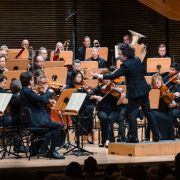
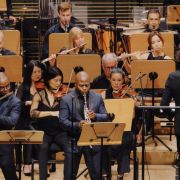
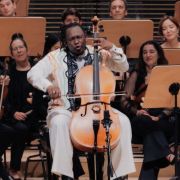
Shostakovich’s Symphony no. 4 in C minor is the one he was forced to withdraw (before its premiere) once Stalin took exception to his opera Lady Macbeth of Mtensk. The later, Soviet-approved Shostakovich flirts with modernist dissonance; this symphony bypasses flirting and has mussed hair and lipstick on its collar. It is Mahleresque: gargantuan in scope, an hour long and calling for a huge orchestra. On Wednesday, Gianandrea Noseda conducted the New York Philharmonic in a lovingly crafted, exhilarating rendition.

They took full advantage of the Wu Tsai Theater’s kindly acoustics. Every texture was crystal clear, from Judith LeClair’s frequent bassoon solos supported by barely-there strings to the in-your-face, “my orchestra goes up to eleven” climaxes in which really no one should have been audible over the low brass and percussion, but everyone was. The strings were capable of both savagery and sinuousness, with their first-movement Presto passage sounding like a swarm of malevolent bumblebees. The woodwinds roamed confidently through manic changes of affect, from exuberance to paranoia.


The symphony has structural challenges: there are several sudden, unprepared shifts in tempo to make sense of, not much obvious in the way of thematic unity in the long outer movements, and a bewildering array of moods and textures. Noseda handled the majority of these beautifully and, in an unexpected masterstroke, began the second movement after barely a pause, so that rather than a dance-like respite it registered as a haunted reflection on the first movement’s angst. There was still that one sudden shift in the third movement that sounds for all the world like there’s a page missing from the score. And there are long stretches of satirical waltz, whose banality seems to be their point, that allow the momentum to sag and the mind to wander. But the third movement’s boisterous, slightly dissonant false climax was immensely satisfying, as was the gloriously creepy final passage.

The program also featured Behzod Abduraimov, in his New York Philharmonic debut, in the Tchaikovsky First Piano Concerto. The hall’s acoustics are not quite as friendly to concertos; in any passage louder than, say, mezzo-piano conductors seem to have to choose whether to keep the orchestra under a blanket to allow the soloist to be heard or let the orchestra play out and bury the soloist. Noseda chose the former approach for the iconic opening melody, allowing the famous ascending quarter-note block chords to be heard, but the latter for most of the performance.


Luckily the concerto has plenty of softer and even solo passages, so we could hear Abduraimov’s stunning control of phrasing in melodic material, whether delicate single-line heartbreakers or thundering alternating octaves. The gestural material – sweeping flourishes, filigreed arpeggios – seemed less intentional, which was a disappointment. There was a terrific groove to the third movement’s theme, though, and nicely subtle variations to its recurrences. And the advantage to letting the orchestra have its head is that the big climaxes can be as gratifyingly raucous as one could wish.