It is not usual to think of Bela Bartók, Igor Stravinsky and Dame Judith Weir as being pastoral composers, but in an engaging concert at the Barbican there they were on the same stage with Gerald Finzi, a composer whose work is infused with a very strong sense of the bucolic. Hats off, then, to Sakari Oramo, Yeol Eum Son and the BBC Symphony Orchestra for an enterprising programme which revealed sonic affinities not otherwise obvious from seeing a list of works comprising Bartók’s Piano Concerto no. 3, the 1945 suite from Stravinsky’s The Firebird, Weir’s The Welcome Arrival of Rain and Finzi’s Eclogue for Piano and Strings. The revelation of those affinities might be summed up as affording glimpses of vivid landscapes of the imagination filled with night-birds, fire-birds, evil wizards – and a horned-god.


Yeol Eum Son’s performance of the concerto and Eclogue either side of the interval showed two distinct aspects of her superb artistry: the former executed with a range of expressive detail that tingled, crackled and fizzed; the latter delivered with a reflective warmth infused with bright touches of colour. Her languid evocation of Bartók’s countryside at night had its corollary in a day-dreaming recitation of Finzi’s poem – and what a magical evocation it was. Finzi’s landscape is not one of bleating, lowing or neighing; it’s that place on an island in the Thames where, in The Wind in The Willows, Kenneth Grahame gives us a glimpse of the great god Pan, a vision at once unexpected and vivid. Son’s eloquence, wonderfully supported by the strings, was a fine gesture to the composer for the 70th anniversary of his death.
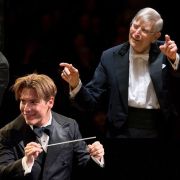
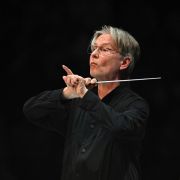
A rather different kind of evocation of an enchanted landscape was provided by the orchestra in a heady performance of The Firebird. If in the Berceuse the melting phrasing of the soloists would have lulled Bartók’s birds to sleep, in the Infernal Dance the menace of the brass would have forced Pan to flight. As he rang the changes that gives Stravinsky’s score its compelling narrative, Oramo was a joy to watch. It would be easy to say that he provided his own choreography to animate the drama, but that is at the heart of how he works with his players.


One should be careful to avoid giving literal interpretations to Weir’s titles but The Welcome Arrival of Rain really was conceived as an act of celebration, for the descent of the monsoon season. While her rhythmic and harmonic sensibilities cannot be confused with those of Stravinsky, this terrific, atmospheric orchestral study which opened the programme was played with such intensity it might have been the storm which prefigured the dark rumblings of The Firebird’s opening bars. But that idea, along with all the other fanciful rumination, was blown away by the encore, Stravinsky’s Galop, bursting into the hall like Petrushka’s country cousin.