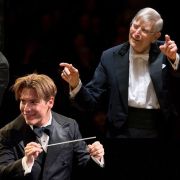


“If, after my death, something doesn’t sound right, then change it. You have not only a right but a duty to do so,” Gustav Mahler once urged Otto Klemperer. Petr Popelka is hardly given to the extensive revisions that were one of Mahler’s hallmarks as a conductor, yet he and the Wiener Symphoniker demonstrated that something more fundamental can be transformed almost without changing a note.

The Konzerthaus matinée opened with a selection from Des Knaben Wunderhorn. Andrè Schuen, a refined Kavalierbariton with a warm, rich timbre and a velvety upper register, was at times overpowered by an orchestra not always attentive to balance. The most persuasive moments came in Wo die schönen Trompeten blasen and his encore, Urlicht, where the sparser scoring favoured the natural ease of Schuen’s cantabile and his sensitivity to the verse.


Mahler’s Fifth Symphony, with its notoriously dense writing (in 1904, Alma returned home in tears after a rehearsal, unable to make out the themes she knew so well), likewise suffered from imbalances between sections – particularly in the first three movements, as brass and percussion too readily dominated.
There is a difference between a principal motif being eclipsed by competing lines as part of the composer's design and structurally secondary elements gaining the upper hand for merely incidental reasons. The latter repeatedly obscured the former here, blunting the work’s tragic force. But after a finely shaded, ethereal Adagietto, the contrapuntal Finale restored a clearer sense of internal hierarchy, building towards a triumphalist élan that won the audience over.

The Symphoniker displayed seasoned assurance in their solos and cohesion as an ensemble, although one might have wished for a more sustained legato from the strings and less metallic-sounding pizzicati. Some details reflected established traditions – this is Vienna, after all. The final note of the Trauermarsch, for instance, was played forte, although Mahler marks it sforzando within a pianissimo context. It is a reminder of how little it takes to alter the character of a phrase.


Popelka’s reading was energetic, driven by flowing tempi, a certain rhythmic and agogic firmness, and little genuine concession to rubato; the resulting regularity left few surprises. Throughout the symphony, he seemed more concerned with adhering to the rhetorical surface of the score (“from darkness to light”) than with bringing out its uncanny dimension, more intent on establishing an apparent unity than on tracing its underlying fractures.
Leaving the Konzerthaus, I found myself thinking of Hans Holbein’s painting The Ambassadors: a strange object on the floor reveals its disquieting nature only when observed from a particular angle, otherwise remaining concealed.