This momentous event was the first performance of a new century for Rambert, which traces its origins to a performance of A Tragedy of Fashion, in June 1926, choreographed and performed by Frederick Ashton, then 23-years-old and working as a butcher’s accountant. Serge Diaghilev, sitting in the audience at that debut performance, offered to audition Ashton for his Ballets Russes but it was not taken up. How different might the course of British ballet history have been!

Here I am, dwelling on the sentiment of history, which to Rambert’s credit, they are not, choosing to celebrate their centenary with the strap line “We’re 100 and we’re just getting started”! This programme looked forward with no direct reference to the company’s illustrious history as the UK’s oldest dance company, having morphed from classical ballet to contemporary dance on that journey.
Instead of selecting the greatest works of the previous century, the triple bill represented a kind of 3-2-1 in creating choreography, bringing together the quick revival of a work from Rambert’s recent collaboration with (La) Horde, a trio of multi-disciplinary artists currently directing the Ballet National de Marseilles; the world premiere of a work by a choreographic duo new to the UK; and a 2025 commission that premiered in Edinburgh by Dutch choreographer, Emma Evelein, whose work had also never previously been seen in Britain. Introducing new choreographers is always a risky venture, to be applauded for the sake of innovation.


The intended order of the programme was clearly changed between the printed version and the performance with the new work, In Crimson, opening proceedings and the intended starter, Gallery of Consequence, replacing it as the finale. I have no clue as to why the change was made but the order seemed to make sense in terms of momentum.
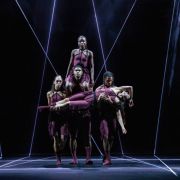
In Crimson by joint director-choreographers Bobbi Jene Smith and Or Schraiber is an eclectic series of vignettes that ostensibly takes place in front of the closed curtains, giving an interesting take on the theatre’s fourth wall. A central focus of the work is pianist, Yonatan Daskal, placed at the extreme left of the limited stage space: he plays both the piano and a miniature electronic hand-held organ, including his own original compositions mixed in with the work of Bach and Bizet.

The choreography produces extreme challenges for the small group of dancers, amongst whom Naya Lovell stands out, especially since this multi-talented artist sits on Daskal’s piano and sings a sensual cabaret song, Barbara’s La Solitude, with great distinction. The work is a sexy and taut mix of vignettes, danced with elegant physicality, and always shrouded in the mystery of what lies behind those closed curtains.
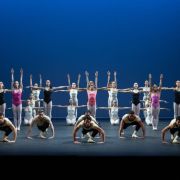
Evelein’s Gallery of Consequence started with repetitive and frenetic walking around by a large ensemble, some travellers pulling wheeled suitcases, and in case of confusion, a departures board listed various destinations to prove that this plethora of movement was in an airport. Although this Terminal was clearly unreal since every plane was denoted as being either ‘on time’ or ‘boarding’, and an airport without a single delay on display is a very rare beast. I would have been worried, as a passenger, since planes were “boarding” at 3am and 8pm and yet they were all on time. The allegorical aspect of AMIANGELIKA’s video design of the “departures board” was evidenced by the occasional destination references changing to ‘Alone’ or similar.


The work is danced to an eclectic soundtrack, linking half-a-dozen or more sources, and the choreography did not suggest any particular style, although it was a work that engaged most of the Rambert dancers and, at this scale, it was often impressive in terms of different movement languages happening simultaneously, but also in harmony. Evelein and her team have certainly captured the apparent chaos of a busy airport whilst also managing to focus on the human connections sometimes found in transit.
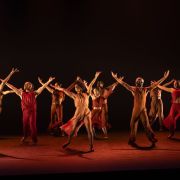
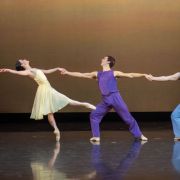
These newer and new works had merit, but the star of the evening was the revival of (La) Horde’s infectious Hop(e)storm, first performed a year ago at London’s Queen Elizabeth Hall. The joyous non-stop Lindy Hop movement might start from a simple enough base, but the pulsating energy is remarkably effective, and I challenge anyone not to be seduced by it. The dancers must have needed an ice bath at the conclusion but, a few minutes later, they had to return for Gallery of Consequence. The programme order would have worked better with the blazing Hop(e)storm as its finale.

Full marks to Rambert’s artistic director, Benoit Swan Pouffer, for stressing the future in this anniversary programme. Innovation comes at a price, which is that not everything is guaranteed to be successful. Despite its mixed bag nature, Rambert have used their centenary to introduce new choreographers and their work to the UK, and that is to be applauded.