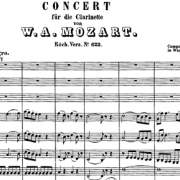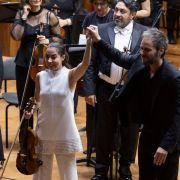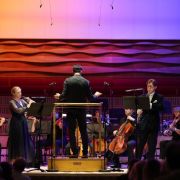


The Royal Liverpool Philharmonic Orchestra has a star in its principal clarinettist Miquel Ramos Salvadó. His performance of Mozart’s Clarinet Concerto was amazing. It is Mozart’s last completed major work and one that has been a mainstay of the clarinet repertoire since it was first performed. It appears frequently in the schedule of orchestras and is understandably popular, but this time but I felt as if I was hearing the work for the first time.

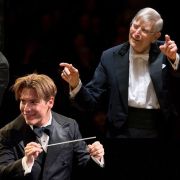
Ramos imbued every note with meaning. His body language was striking – he moved with the music as if to give it an extra layer of expression. The slightest of phrases had a new significance and his playing was beautiful throughout. The sublime melody at the start of the second movement was breathtaking, but Ramos discovered moments of darkness and elements of humour as well. His rapport with the orchestra and the conductor (the RLPO’s chief conductor Domingo Hindoyan) was clearly ideal. He could often be seen looking at his colleagues, especially when not playing himself. The jaunty finale proved to be a striking contrast with the preceding Adagio. The whole was a perfect collaboration and simply the best performance of this concerto that I have experienced.


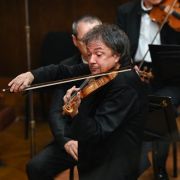
Before the Mozart, we heard the prelude to Korngold’s “ballet-pantomime” Der Schneemann. It proved to be a sweet, tuneful piece with a prominent part for solo violin taken by the orchestra’s leader Thelma Handy. It is hard to believe that this was the work of an eleven-year-old, even if he had some help in the orchestration from his teacher, no less a composer than Alexander von Zemlinsky. It formed a genial opening to the concert.
The second half of the evening began with The Observatory by the RLPO’s “composer in focus” for this season, Caroline Shaw. It was inspired by seeing Los Angeles from the Griffith Observatory above the city and was first performed in that city in 2019. In it, the composer aimed to express something of the vastness of space and its contrast with human life. The work begins and ends with some huge chords but the focus can change in a moment to just a small group of instruments. The use of tuned percussion was particularly noticeable. There were some brief allusions to music by other composers including Bach, Sibelius and others. There were some remarkable sections in which one section of the orchestra seemed to be slightly out of step with another; the composer has explained this in astronomical terms. All in all, it was an intriguing and engaging piece, worth hearing again.
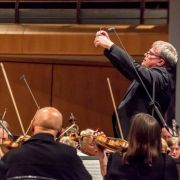
The final piece this evening was by Hindemith. Hindoyan and the RLPO are rare proponents of this underrated composer and they gave a fine performance of his Mathis der Maler Symphony. The symphony was created alongside his opera about the Renaissance artist Matthias Grünewald and the symphony’s three movements relate both to parts of the opera and three panels of the artist’s masterpiece, the Isenheim Altarpiece. The richness of the score may be enhanced by some familiarity with the Altarpiece, but it works perfectly well as a free-standing abstract piece of music. Much of it was serious and uplifting. The opening Angelic Concert was characterised by glorious chords with brass predominating. The equally glorious conclusion of the symphony followed a vivid depiction of the temptation of St Antony. The central Entombment movement was sad but entirely beautiful. Hindoyan lavished care and insight on this wonderful work and the orchestra communicated it powerfully to the audience. As I always say when I hear them play this composer, more Hindemith, please!