Solera is the seventh collaboration over almost a quarter of a century between Paco Peña, the master of toque, the flamenco term that describes a guitarist’s special touch, and Jude Kelly, the former artistic director of the Southbank Centre. Peña brings his own masterful command of guitar and an ensemble of outstanding flamenco artists while Kelly’s directorial flair has created a significant sense of theatre to showcase the traditional art of the tablao.

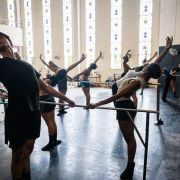
Solera has an interval, a rare occurrence in flamenco, with the break representing an important distinction between the opening rehearsal process, with the nine performers arriving as if from the street, and the absorbing professional tablao of the second act. The audience was transported from the austerity of a bare studio, its space augmented only by the clutter of clothing rails and backpacks, to the romantic representation of a sultry evening in Córdoba. Praise is due for Tom Wickens’ vivid and varied lighting designs, which played an emphatic part in maximising the impact of this transition.


Peña is approaching his 84th birthday on 1st June, and the sensitivity and expressiveness of his instrumentalism appears undiminished, even if in Solera it seems to be delivered in shorter bursts than in previous productions, such as Quimeras (2012) and Flamencura (2015).
Age is of significance to Solera, since the term describes the process for maturing wine, whereby younger vintages are gradually added to older casks to produce a consistent blend. It provides a subtle allegory for this production, since the performances of young dancers, singers and musicians were mixed with those of maturity – including, of course, Peña himself – to create an exciting blend of flamenco.

Peña’s musicianship was beautifully harmonised with the expressive toque of Dani de Morón, especially in the reinterpretation of a haunting farruca, composed by the legendary Romani guitarist, Sabicas, which was a late highlight of the rehearsal act. The whole of Solera was effectively a series of conversations and in this farruca the virtuoso, rippling interplay between Peña and de Morón was mesmerising and impossible to distinguish their respective contributions, other than in the stark contrast between their instrumental stances.
Peña’s unique trademark style requires an upright back, with his guitar held permanently at 45 degrees from its resting position on his thigh, whereas de Morón folds his upper body over the guitar, held horizontally, closely observing his fingers as they caress the strings. They were joined by a third guitarist, Rafael Montilla, a regular with the Paco Peña Company since 2001, in a delightful second act performance of Mantilla de Feria, made famous by the legendary Paco de Lucía.
This same mix of experience and youth was present in the singing. Iván Carpio was born in 1988, at which time Inmaculada Rivero’s career was already in full flow. Her anguished soul-searching vocal twists possessed an arresting, unearthly power of expression, which Carpio – who hails from a distinguished dynasty of cantaores – took up like the baton in a vocal relay. The ensemble was backed by the percussionist, Julio Alcocer, another Peña regular (since 2012) who opened the second act with a veritable symphony of taconeo that beggared belief that all the various percussive rhythms were the work of one man!


The dazzling rhythm of bailaor Ángel Muñoz, now in his 53rd year, is also undiminished with sparkling zapateado (the rhythmic beats of his footwork) in a captivatingly expressive soleá and a lively alegrías following on from the cantes por alegrías sung meaningfully by Carpio and Rivero. The essence of Solera was again present in the dance reciprocity between Muñoz and the young Brazilian bailaor, Gabriel Matias, as if an experienced warrior was mentoring a talented young disciple.
This revival of Solera was not quite the same cast as in 2022 since the intended bailaora, Adriana Bilbao, was replaced at short notice by a member of her own company, Magdalena Mannion, who is jointly based in London and Madrid. Mannion has complimented her own Amor de Dias training with spells at Northern School of Contemporary Dance and the Merce Cunningham Studio in New York and her elegant versatility was evident throughout her performances.
Fernando Romero’s choreography presented greater challenges for the two men although the first act ended with Mannion showing her proficiency in manipulating a bata de cola (the traditional flamenco dress with a long train) through a sensual tangos. Apart from this frilly dress the whole of the first act was, in keeping with the idea of a rehearsal, performed in “own clothes”, ranging from adidas sportswear to leisure wear.
With this excellent blend of the experience of maturity and the enthusiasm of youth, Peña and Kelly have once again delivered a sensational and sensual theatrical experience that sets up London (and Sadler’s Wells) in splendid anticipation for this year’s Flamenco Festival, which arrives for the last two weeks of June.