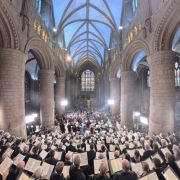
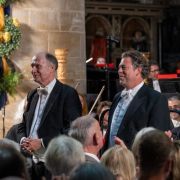
It isn’t always clear who to blame at a concert: the performers or the venue. On Saturday evening, listening to the South Cotswold Big Sing Group and British Sinfonietta, conducted by Adrian Partington, within Tewkesbury Abbey, it appeared to be the proverbial six of one, half a dozen of the other.

Problems were immediate. Despite some instances of sloppy coordination, Brahms’ Academic Festival Overture was nonetheless reasonably rousing, in a generic kind of way. Yet the way it emerged through the Abbey’s reverberant acoustic made it seem as if half in a dream. It wasn’t helped by Partington’s non-descript, entirely literal interpretation, making him seem little more than a time-beater. By the end, though, in the work’s large final climax – being performed on this occasion in the pimped-up choral finale version arranged by Malcolm Sargent – the choir, despite its apparent best efforts, were completely swamped by the orchestra, in what came across as a crass overload of noise.


It was an unfortunate sign of things to come. In Bruckner’s Te Deum, try as they might, precious little pitch clarity emerged from the soloists’ forceful efforts, rendered here as wobbly and gelatinous. They were at their best, as was everything, when the tempo relaxed and the music turned quiet and reflective. Ah – air, light! Without the orchestra blaring behind them, sounding almost subaquatic in the Abbey’s acoustic soup, these were moments of touching intimacy. But only moments: Partington often visually appeared to be fighting the enervating effects of the reverb, and he opted for a full force, relentless approach. The momentum felt blank, the tone polarised, the chorus soft or shouting. A Te Deum less about glory than mere bulk.
None of those bode particularly well for Mahler’s Das klagende Lied. That being said, the qualities of the score enabled a distinct and effective change of atmosphere. For the first time we experienced real space, line, counterpoint, even a touch of elegance, enabling Partington to tilt efficiently between darkness and glimpses of light. Yet it often fell to the brass to bring clarity, their heraldic brightness a stark contrast to the muddy, low register textures beneath them. Likewise the flutes, the one instrument of the evening to ring out with real certainty. Contralto Claudia Huckle was also very strong here, an invaluable focal point, yet she was all too easily drowned out.

Whether the choir was anguished or simply raucous was impossible to tell. The Abbey acoustic seemed by this stage determined to render things impenetrable. Bright fanfares turned to stodge, words were indiscernible without a bit of long-distance lip-reading – yet, almost implausibly, Mahler’s drama just about won through, though not as detail but as shape.


The work’s latter stages pushed the best and worst aspects of the concert to extremes. At Was ist der König so bleich und stumm? we finally experienced significant clarity, from Huckle again but also the orchestra, reduced now to a delicate ensemble of flute, piccolo and harp. A palpable poignancy coloured the lament as it continued, Partington eliciting some genuine emotional weight from the orchestra by keeping things measured. Yet the denouement was nothing short of catastrophic. As Mahler’s castle collapsed, so did the entire musical edifice. Mess and pandemonium were everywhere, voices and instruments intermingling in an impossible echoing blur. Individuals strove to be heard, only to exaggerate into shrill shrieks above and a thick quagmire below. By its end it had become a pure wall of noise that was simply horrifying to endure – no longer Mahler, barely music.