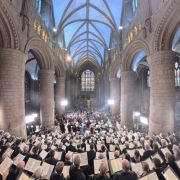
Saturday evening’s opening concert at this year’s Three Choirs Festival manifested three quite distinct forms of exuberance. The first came from Gavin Higgins, in the UK premiere of his short Fanfare Americana. Above, ebullient and bright with chatter, while below, slower lines kept things just about grounded. Despite being a bit too derivative of Oliver Knussen in its spritely middle sequence, Higgins’ material was arresting and involving throughout, with strong energy and some effective orchestrational touches. It was an ideal way to prime Gloucester Cathedral for what was to come.

For Elgar, the exuberance running through his First Symphony is one of pure positivity. Its opening theme was rendered by Adrian Partington with such stately calm it sounded like an incongruous valediction. Yet it was a good move, not merely setting up the work’s default position but hinting at its culmination. Some might cry “spoiler alert!”, but the performance made clear the extent to which this is not a symphony based on conflict and jeopardy, but on the playful, fizzing tension arising from contrasting impulses. As such, the Philharmonia was able to lean in – hard – to the first movement’s episodes of roiling turbulence, the theme returning like a rainbow after ferocious storms, returning things to an atmosphere of quietened intimacy.


These opposing forces were sharply crystallised in the middle movements, plunging headlong into the crashing torrents of the Allegro molto (Elgar pointedly never called it a Scherzo), Partington making its fugato sound more like a drunken round. The ensuing Adagio spoke with buoyant lyricism, positivity now become certainty, the orchestra attaining an exquisite hush at its close. The finale came as perfect synthesis, the theme continuing to make its presence felt through the remaining bouts of punch and clamour, indefatigable to the last. Partington made its apotheosis bubble with joy, the orchestra practically laughing through the final climax.
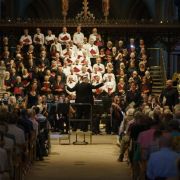
Exuberance of a very different order came in Walton’s Belshazzar’s Feast. The context – its complete opposite – cut through the cathedral like a white-hot blade, the Festival Chorus giving a superb account of the opening lament, their plaintive lines made more pained, even nasty, through conflicting emotions of keening and violence. When his time came, baritone David Stout (positioned rather oddly at the side, almost out of sight) resounded like a prophet, by turns fraught, solemn and distressed, provoking an angry response from the massed voices.

Now came the cause, a seemingly unstoppable superabundance of merriment, and while many of Walton’s deft sound effects – particularly the allusions to the materials associated with the various gods – were hard to discern in the orchestral texture, the huge sense of swagger and confidence was unequivocal. The chorus made the text’s periodic tilts into critique nicely cutting, and at the appearance of the writing on the wall, Stout coloured his blunt account with the barest suggestion of relish.


“Slain!” Has a single word ever proved more catalytic in music? A different kind of synthesis now, the exuberance of the whole concert mingling with Higgins’ electricity and Elgar’s positivity in an enormous outpouring of relief and exultation. Partington made Walton’s syncopations into a dance, chorus and orchestra pulling angular shapes in pure celebration. Echoes of the start made a poignant resonance – elation no less blood-stained than lament – before the dance reached its apex, overflowing and overblown, magnificently massive.
The work's morally ambiguous treatment of the narrative – different gods, worshippers and beliefs: whose is ‘right’? – remains unusual and compelling. Nearly a century after its premiere, the work’s unflinching, dramatic engagement with humanity’s deepest impulses is as vital and powerful as ever.