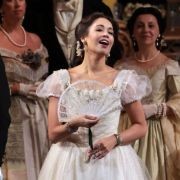
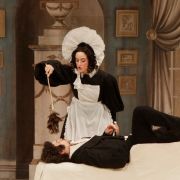
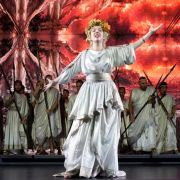
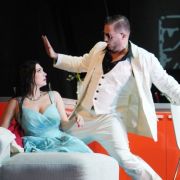
Giacomo Puccini’s Tosca, which premiered in Rome in 1900, is based on a play by Victorien Sardou, written specifically for the legendary actress Sarah Bernhardt, the quintessential diva of her time. In the Wiener Staatsoper’s classic production, Anna Netrebko proved to be an ideal choice for the title role, both vocally and dramatically. She embodied Floria Tosca, a fictional great opera singer of 1800, with such authenticity that it felt as though she were portraying herself – Floria Tosca could easily have been the Netrebko of her era.

One of Netrebko’s greatest strengths is her ability to fully immerse herself in every role she performs. This was no exception. Her demeanour oscillated between assertiveness and vulnerability as Tosca is crushed by the unfolding tragedy, leaving her no time or capacity to process the horror. Vocally, Netrebko was in fine form, although there were moments where her breath control faltered, slightly disrupting her legato. That said, her middle range was powerful and smooth, high notes brilliant and secure, delivering high Cs with confidence, even a touch of swagger. Yet her most striking gift remains her pianissimi: rounded, shimmering and utterly heartbreaking.


Her lover, Mario Cavaradossi, was portrayed by Ivan Gyngazov, whose secure, powerful high notes were warmly received by the audience. His rendition of “Vittoria!” was particularly impressive. However, he seemed to lack the bel canto technique that could have softened his otherwise muscular tenor, even within the verismo style. As a result, his legato was less fluid, his vocal emission throaty and his timbre often harsh. His stage presence felt uninspired, though this may have been due to limited rehearsal time, a common issue with revivals at this house. For instance, he showed little emotional depth during his confrontation with Scarpia.

Christopher Maltman took on the role of Scarpia, arguably opera’s most malevolent villain, a sadist who revels in the suffering of his victims, a predator who wields his power and veneer of respectability to terrorise and dominate. Maltman’s interpretation leaned less toward the elegant, sophisticated sociopath (à la Tezier) and more toward the lecherous older man, skirting subtle vulgarity without ever crossing the line. His rich, elegant baritone seemed slightly compromised, but he skilfully concealed any issues and navigated the role’s many challenges with finesse. The Te Deum was commanding and powerfully projected, and his second act was simply superb. Together with Netrebko, he delivered one of opera’s most dramatic scenes with conviction and vocal brilliance. Netrebko switching between asserting her agency as a woman with a will and succumbing to the terror and disgust Scarpia provoked in her. Maltman masterfully conveyed the sadistic pleasure of watching her squirm. When Tosca finally stabs him, Netrebko hit twice, with furious violence, screaming her hatred into his dying face as he was pleading for his life, and it was perhaps the most compelling Scarpia death I have ever witnessed.


Daniel Oren drew a sumptuous sound from the Staatsoper orchestra – an achievement that, while not particularly arduous, was nonetheless glorious. The brass were commanding and the lush waves of the strings were rapturous. At times, the orchestra slightly overpowered the singers, but Oren generally maintained a good balance. Clearly trusting Puccini’s score, he revelled in its details, although this occasionally resulted in sluggish tempi that did not always serve the singers well, particularly in “Vissi d’arte” where a faster pace might have suited Netrebko better.

Margarethe Wallmann’s production, which premiered in 1958, has seen over 600 revivals and shows no signs of aging. In an era dominated by modern, ugly stagings, it’s refreshing to encounter a classic, traditional production that faithfully tells the story as written in the libretto, and it's beautiful to look at. It feels like a breath of fresh air, allowing the audience to relax and simply enjoy the narrative and music rather than puzzling over a director’s cryptic reinterpretation.
Designed by Nicola Benois, the stage is meticulously detailed. In the first act, the church of Sant’Andrea della Valle feels vast and immersive, with prelates and choirboys faintly visible in the background, going about their routines as the drama unfolds in a foregrounded corner. The altar, though offstage, is unmistakably present, with characters repeatedly crossing themselves toward an unseen location, and the crowd facing it during the Te Deum. These details reflect a profound knowledge and love for the art form, offering a delightful, old-fashioned approach that enhances the production’s timeless appeal.