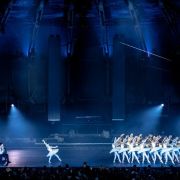
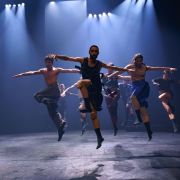
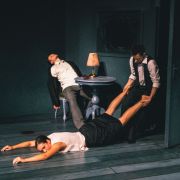
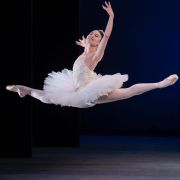
The Nederlands Dans Theater’s main company, NDT1, started the new year with a double bill, beginning with a world premiere entitled Kid in a Candy Shop by first time collaborator Jan Martens, and closing with Horses by NDT associate choreographer Marcos Morau. Both works were seemingly paired to provide an evening of contrasting dance landscapes, rich in choreography that complemented their respective elaborate and evocative musical scores.

Choreographed by Belgian choreographer Jan Martens in collaboration with the NDT dancers, Kid in a Candy Shop is a 40-minute dizzying display of disjointed neoclassical gestures infused with contemporary movements that brought almost the entire main company onto the stage. The piece is set to two significant works of contemporary classical music by Julia Wolfe and Hanna Kulenty, both compositions exploring complex rhythmic patterns and dynamic tensions that are reflected in the movement.
The work is divided into two sections aptly titled in dedication to each composer. Wolfe begins with a handful of dancers onstage, streamlined in unitards of muted pastel colours of dusty pink and green, spring colours that mirror the backdrop which projects time-lapse images of flowers in bloom credited to British naturalist and nature documentary pioneer, F. Percy Smith.


The dancers embarked on a journey of movement based on classical ballet peppered with waltz sequences and walking patterns that traversed the stage. This movement exploration continued in the second section, Kulenty, where a new group of dancers, this time in matching blue grey unitards, played with whizzing chaînés patterns and twitches that required the dancers to hit classical ballet poses of tendus and arabesques in time with the score like on/off light switches.
Martens, in collaboration with the company, seemed to throw every dance style (plus the kitchen sink) into the mix which left me both buzzing and paradoxically wanting more. An interesting exploratory duet between Conner Bormann and Anna Bekirova, though visually satisfying with their long limbs and extensions that accentuated their beautiful classical lines, felt prematurely cut short. Similar sentiments go to the absurdist exchange between Scott Fowler and Genevieve O’Keeffe and a vibrant, twitchy (mini) solo by Barry Gans. Sophie Whittome performed with much aplomb in both sections, ending the piece with a final and fully realised solo that hinted at The Rite of Spring.

Two moments of reprise gave the audience time to luxuriate in the dancers’ incredible physical control where seemingly suspended in time, a handful of dancers moved breathtakingly slow while standing either on one leg or on relevé. The gradual rise and fall of bodies evoked images of seedlings slowly blooming, allowing the audience to digest the impressive musical score.
The relentless repetition of classical ballet positions that bordered on camp would have been fun to see expressed in the dancer’s faces which remained neutral throughout. I also wondered how the piece might be enhanced with the addition of live musicians which was the case when Wildsong debuted at the Holland Dance Festival accompanied by the Dutch Ballet Orchestra. And the reverence for classical technique made me speculate how a ballet company might approach this work, which rarely crosses my mind when watching NDT. That being said, Kid in a Candy Shop seems poised to push NDT in new directions, an exciting prospect for both the company and audiences alike.


NDT ended their programme with Marcos Morau’s Horses, a piece well within the company’s present DNA. Cleverly timed with the Chinese New Year, Horses, which debuted in 2024, is a conceptual work that invites the audience into a darkened liminal space where eleven dancers move through a series of eerie fragmentations and propositions that centre around ideas of light. Master of moody lighting design, Tom Visser is in his element here, giving the space a poetic and cinematic feel while Silvia’s Delagneau’s costumes – pants and dress shirts – are worn like flexible armour that allow the artists to move with abandon. A touch of the comic is accented in the use of shoulder pads, somehow matching the moody soundscape sprinkled with distorted spoken word and laughter from a sitcom laugh track.

Traces of the absurd were infused with surrealism, film noir and the macabre. Contorting their bodies in various formations, and subversions of horse-play, the dancers moved low to the ground which emphasised the vast void of blackness that inhabited the stage. All eleven dancers were impressive in their artistry and athleticism that it feels almost criminal not to credit them each by name for their inspired work. While Scott Fowler was a magnetic presence – someone who seems wholly grounded and committed every time he enters the stage – my MVP of the night would have to be Rui-Ting Yu, who approached her role with fearless virtuosity.