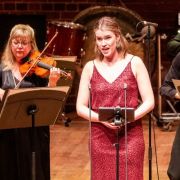
The Britten Sinfonia’s second concert at this summer’s Aldeburgh Festival offered tales from Greek mythology. One god (Apollo), one hero (Ulysses) and three women, each in extremis (Medea, Ariadne and Phaedra). The strings of the Sinfonia, deployed in various sizes and combinations across the evening, were directed by lead violinist Zoë Beyers, although such is the cohesion of this group they need do little more than watch her bow, their tight discipline evident even at swift tempi.

A swift tempo despatched Britten’s Young Apollo for piano and strings in barely eight minutes. The young Sun God is taking on his godlike form and entering Olympus, “quivering with radiant vitality” as Keats says in Hyperion, one source of the work’s inspiration. Iain Farrington relished the storming scales and swooping glissandi of the piano part and the strings played with such unanimous rhythmic drive they ended sharing beaming grins with each other. We all smiled too.
Woolrich’s Ulysses Awakes takes the aria from Monteverdi’s opera Il ritorno d’Ulisse in patria where Ulysses awakes on Ithaca, after years of wandering, unaware he has reached home. The aria is given to a solo viola and a group of ten strings, and the Sinfonia’s Wenhan Jiang made much of his questing melodic line, as if Ulysses was searching still.

Medea, rejected by her husband Jason, recalls the sacrifices she had made for him, with calmness, not yet revealing the vengeance she will take, murdering their children. From Charpentier’s opera Médée, we heard the Act 2 aria “Quel prix de mon amour” (What price has my love?). Helen Charlston, fast becoming the leading mezzo-soprano of her generation, even a mezzo with contralto weight at times, sang with effortless authority, transporting us to ancient Corinth and her moving plight. She was no less enchanting in Haydn’s cantata Arianna a Naxos, the most substantial piece in the first half. Its arias and recitatives unfold Ariadne’s search for her lost love, Theseus, then her realisation he has abandoned her on Naxos, (sudden top note nailed), then the fiery exclamations of a woman scorned. No mere vocal exhibitionism here, just a convincing dramatic re-enactment.
Apollo returned to open the second half with Stravinsky’s Apollon musagète (Apollo leads the muses, later called just Apollo). Scored for a chamber group of strings, it might have been written for the Britten Sinfonia. Here they played as well as ever, in this ballet score in which Apollo is visited by three muses: Terpsichore, muse of dance and song; Polyhymnia, muse of mime; and Calliope, muse of poetry. The final apotheosis, where Apollo leads the muses up to Parnassus, was the most radiant of the various transcendent moments in the programme. We did not need stage or dancers to reveal the significance of Stravinsky’s inspired coda.

An inspired coda to a career creating great vocal music came with Britten’s Phaedra premiered fifty years ago in this very hall at the 1976 Aldeburgh Festival (Britten’s last). The text derives from a translation of Racine's Phèdre by Robert Lowell. Charlston’s diction is excellent, so the audience had no hiding place from this unflinching tragedy, right up to the effects of “Medea’s poison... chills already dart along my boiling veins and squeeze my heart.” Charlston was unsparing in this vivid depiction of the appalling welcome for Phaedra’s chosen cure of her unhappy state. “Phaedra in all her madness stands before you,” sang Charlston, and she certainly did. Perhaps the only possible piece to close this terrific programme, Britten’s last major work transfiguring his own festival.