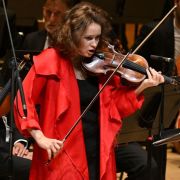
This London Symphony Orchestra concert under their now Conductor Emeritus Sir Simon Rattle opened with the Violin Concerto no. 2 of Béla Bartók (1938). It is his only mature concerto for the instrument, and one of the great ones of its era (among six or seven others from the 1930s). Alternating between the folksy and the ferocious, its 40 minute length is a test for any soloist. Although the composer’s first version of the finale ended with the orchestra alone, Hungarian violinist Zoltán Székely, who commissioned the work, suggested it was better for the solo part to go right to the end. That was what we heard tonight (as we almost always do). Perhaps one day a violinist will be self-effacing enough to let us hear the original ending – all forty seconds of it.

But no-one could have begrudged Patricia Kopatchinskaja, opening her LSO Artist Portrait series, as full a part as she wished, given her typical risk-taking high commitment. It is easy to overlook the occasional slightly rough passage or moment of intonation less than dead centre when there is such a passionate power of communication. Her rapturous reception was certainly well deserved.
More Bartók launched the second half, his rarely heard Five Hungarian Folksongs. Bartók collected and arranged many songs for voice and piano including the Twenty Hungarian Folksongs of 1929. His treatment in these later folksong settings is so much more than ‘arrangements’ that Bartók felt they could be considered almost as original songs. The five heard here were orchestrated by the composer himself in 1933. It’s a melancholy selection, including The Prison, Old Lament and Complaint, and the other two are not substantial enough to counter that prevailing mood. Rinat Shaham’s mezzo-soprano was pure and engaging, if a touch light at moments for such material, and one might have made a different choice for this, her LSO debut. Selections from Bizet’s Carmen, a role for which she is widely renowned, may have served her better, especially as we were off to Spain next.

Fortunately Shaham was heard again, relishing the Spanish texts of the Introduction, and then the Miller’s Dance, in El sombrero de tres picos (The Three-Cornered Hat). Manuel de Falla’s delightful score is usually represented in concerts by its short orchestral suites, but here we heard the complete ballet which, at just 35 minutes, makes a viable concert item. Of course in concert we don’t see any dancing, but we did get the orchestra’s rhythmic clapping and enthusiastic shouts of ¡Ay!, along with the castanets of the opening. The LSO could not have told us more clearly that we were in Spain had they donned sombreros.
Falla deploys flamenco elements, even its sensual cante jondo (deep song), and the LSO responded with alluring orchestral colour. The Iberian dances – farruca, seguidilla, fandango and closing jota – were played with all the seductive charm and élan they need, Rattle obtaining beguiling phrasing and urging on his players in the exciting final dance. London of course has some claim on this music, to the extent that it was first heard here, in 1919 at the Alhambra Theatre (where else?). The absence of the Spanish tourist authorities as we danced out of the Barbican seemed a missed commercial opportunity.