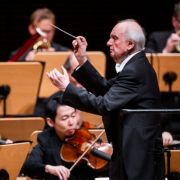
Marek Janowski returned to Geffen Hall this week to conduct the New York Philharmonic in a varied program of Mozart, Haydn and Mendelssohn, his first time return since his belated 2025 Philharmonic debut. On this occasion the esteemed German maestro led a concert to be remembered. The evening got off to an especially elegant start with Mozart’s Serenata notturna.

Among the numerous incidental works the composer created during his early years in Salzburg, this playful piece (1776) is unusual for pairing a string orchestra with timpani (sans the kettledrums’ familiar companion of two trumpets) with a solo concertante string quartet whose lowest voice is a double bass. With only three movements – march, minuet and rondo – as opposed to the usual five or more in most Salzburg serenades – it is also uncommonly brief. Following Janowski’s simple and even gestures, the Philharmonic players brought Mozart’s compact creation to life with brisk rhythms and clear, bright tones. Grounded by Associate Principal Max Zeugner’s rhythmically punchy double bass, the quartet of Philharmonic seniors stood out beautifully against the larger string orchestra, with the spontaneous sounding timpani offering wit and contrast.
Up next was a radiant rendition Haydn’s ebullient Trumpet Concerto featuring Principal, Christopher Martin. Displaying a graceful but boldly projected tone, the soloist tossed off the difficult parts with ease, adding refined touches and masterful flair to his cadenzas while staying faithful to the style of the piece. Under Janowski’s alert direction, his Philharmonic colleagues’ accompaniment was appropriately agile and animated.
Inspired by his 1829 trip to Scotland – in particular his visit to the ruins of Holyrood Chapel in Edinburgh – Felix Mendelssohn’s Third Symphony (“Scottish”) took over a decade to complete before the composer conducted its premiere with the Leipzig Gewandhaus Orchestra in 1842. Under Janowski’s baton, the Philharmonic brought Mendelssohn’s musical travelogue to life in a sprightly account that vividly captured all the mood changes in the tightly knit score, from the dark and dramatic opening bars to the triumphantly blazing finale.

Conducting from memory, Janowski’s pacing masterfully balanced poetic nostalgia with rhythmic vitality. Following the melancholic introduction and turbulent storm music of the opening Andante, Anthony McGill’s buoyant and bubbly clarinet solo in the second movement Vivace came across as especially joyful. In the heartfelt Adagio the tenderly toned strings and beautifully blended woodwinds evoked the melancholy of the Scottish highlands, but it was In the highly contrasting final movement, Allegro vivacissimo, which most impressed. As the forward charging music built up organically, the bright, woody voice of McGill’s clarinet blended perfectly with the deep, rich sound of Principal Judith LeClair’s bassoon in the famous duet which serves as a calm bridge before the thrillingly intense and majestic ending. This was a gripping, propulsive performance of Mendelssohn’s masterpiece, offering a vibrant depiction of the romance and rugged beauty of Scotland.