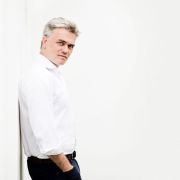
Though the Pittsburgh Symphony season may be approaching a close, last weekend’s memorable debut of conductor Edward Gardner showed there are still musical riches to be found. Anchored by Beethoven and Tchaikovsky, the repertoire wasn’t the most intrepid, yet these fresh takes on the familiar revealed a fruitful and sympathetic collaboration.

Oliver Knussen’s 1988 work Flourish with Fireworks made for an ear-catching curtain-raiser. This four-minute fanfare was written for Michael Tilson Thomas on the occasion of his first season with the London Symphony – and the present performance made for a celebratory tribute to the late conductor. A three-note motto in the brass was an attention-grabbing opening. Though brash on the surface, its subtly shimmering textures were rendered with intricate detail.
Beethoven’s Piano Concerto no. 1 in C major engaged soloist Behzod Abduraimov. The gentle orchestral opening was shaped with nuance and a particularly warm sound from the strings. Gardner’s conception emphasized the work’s grandeur, showing the youthful composer already deviating from Mozart’s pearly models. Abduraimov offered a singing tone in his rippling cascades across the keyboard, duly contrasted by an abundance of fiery octaves.
Adding to its breadth was the deeply-felt Largo and the rhythmic vitality of the closing Rondo, brimming with unexpected key changes and accents. Under Gardner’s baton, all layers of the piece were given with clarity and balance. The pianist’s encore made for a more raucous contrast: a commanding and coloristic take on the Danse russe from Stravinsky’s Petrushka.
Tchaikovsky Pathétique Symphony opened deep in the orchestra’s lowest register, entering an unmistakably tragic realm. Still, Gardner conveyed a broad range of temperament, rallying the orchestra to caustic power, or cresting in sumptuous lyricism. One was entranced by the grand sweep of the melodic line, and its widely-shaped contours were of genuine emotion without sentimentality. Standout performances from the PSO musicians came from the clarinet (Michael Rusinek) and bassoon (Julia Harguindey).
The 5/4 meter of the lush and lilting waltz movement felt natural and not awkward, as if the conductor was saying why shouldn’t a waltz be in five. Yet here it seemed that the dynamic range flatlined, and perhaps there was untapped potential from a wider contrast. The rapid fire Scherzo danced with a lightness of touch, before its mounting gravitas transformed it into a rambunctious march. Mirroring Tchaikovsky’s own biography, it was cut short by the tragic finale, a doleful lament like no other. A somber brass chorale near the close was executed with perfection before the final fade to the abyss.