Sometimes you can tell from the very first sounds that a concert will be out of the ordinary: not the opening chord, not even the conductor’s entrance – but the tuning. The moment the Budapest Festival Orchestra began to settle at Koerner Hall, the sound already had body and bloom, the strings aligned not only in pitch but also in intent. I cannot recall the last time I saw a second-desk cellist shaking her head in admiration at her violin colleagues while waiting for her own entry – a fleeting gesture but revealing of a sheer joy in shared music-making, of listening as fiercely as playing. From the concertmaster, Daniel Bard, to the back desks, there was not a moment of disengagement; the intensity of the performance grew palpably from the intensity of listening.

The concert marked the final stop of the orchestra’s North American tour. Koerner Hall, with its intimate shoebox embrace, might not seem the natural habitat for Mahler’s most expansive symphony: a maximalist retelling of creation and immortality, calling for vast orchestral and choral forces. Instead, the space sharpened the impact. Rather than overwhelming it, the sound filled it with remarkable focus and the audience was drawn into the act of music-making rather than dwarfed by it. That communal charge mirrored the orchestra’s own evident enjoyment. Their listening to one another was infectious.
From the outset, conductor Iván Fischer revealed a conception of striking architectural clarity. The vast first movement unfolded with a sense of inevitability, its sprawling paragraphs shaped into a coherent, breathing organism. There were, perhaps, fewer jagged edges than we sometimes hear, and the primordial eruptions felt less like vulgar display than elemental upheaval. Yet the percussive rumblings emerged with razor-sharp definition. The great crescendo towards summer’s triumphant surge was graded with unerring control, the snarly trumpets and exuberant horns cutting cleanly through the texture without ever crossing the line into stridency.
What impressed most was the balance between architectural grasp and freedom, between clarity of vision and spontaneity. Fischer’s beat is economical, his trust in the players complete. Within that framework, inner voices surfaced naturally. Dionysian, almost gypsy-like interjections flashed through the texture, while elsewhere Fischer allowed phrases to breathe with a flexibility that felt entirely organic.
The flora and fauna of the second and third movements unfolded vividly, with an almost balletic grace perfuming What the Wild Flowers Tell Me. The rampaging wildlife of the third movement gave way magically to shimmering quietude. Playing actually off-stage rather than merely set apart from the orchestra, Bence Horváth’s post horn was suffused with moving simplicity.

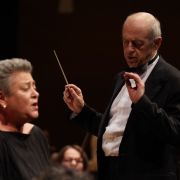
I might have wished for an even closer adherence to Mahler’s Sehr langsam, misterioso in the fourth movement’s setting of Nietzsche’s Midnight Song, if only to savour more fully the velvety timbre of mezzo Gerhild Romberger, as she glided effortlessly over the orchestral fabric. Her every word was charged with meaning and intent, while the problematic woodwind slurs (a recent choice of most conductors to take Mahler’s hinaufziehen – pull upward – at face value) were negotiated as naturally as they could be.
The Toronto Children’s Chorus and Mendelssohn Choir were lively in presence but at times light in impact. Still, the fifth movement shimmered with exuberance. The final Adagio swept aside any reservations, as Fischer allowed it to unfold in a single, breathing span. At this flowing tempo, rubato was daring but never indulgent, the ascent to the above and beyond luminous but never laboured. Even the brazen closing peroration, so often driven to excess, was held in check. What lingered was not sheer decibels but a radiance and sustained glowing intensity that transcended time and space.