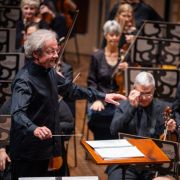
Thursday evening offered an early glimpse of Franz Welser-Möst’s 25th and final season as Music Director of The Cleveland Orchestra, reuniting with his ensemble at the tail end of the summer season. The program was a quintessential Welser-Möst selection, a hearty offering of Austro-German repertoire across the past three centuries, spanning opera, tone poem and contemporary.

The prelude to Wagner’s Die Meistersinger von Nürnberg made for a particularly robust opening. One was immediately engulfed in the gleaming brass and the sheer strength of the full orchestra. Graceful, gentler gestures contrasted with some lovely playing from the winds, only to point to a trajectory that all but guaranteed a grandiose close. It was as if the conductor opened the throttle all the way for this zealous beginning to the evening.
In the program notes, Welser-Möst suggested that Bernd Richard Deutsch’s Intensity counts as one of the most successful of the 47 pieces he’s commissioned during his Cleveland tenure. It made a welcome return to the Severance Hall stage following its premiere four years ago. Though Deutsch’s term as TCO’s composer-in-residence was interrupted by the pandemic, it proved a remarkable collaboration, with his distinctive voice – challenging yet approachable – uniquely well-suited to this orchestra.
Intensity began with thematic material almost bursting at the seams with urgency, punctuated by clangorous percussion. Kaleidoscopic splashes of orchestral color demanded unrelenting virtuosity, a feast for both ears and eyes. Conceived in three connected sections, the central segment turned inward, dreamy and suspended. The vast array of percussion – including rainstick, bells and celesta – made a beguiling soundscape. The angular gestures of the opening returned rapid fire in the final section, yielding a mass of sound that nearly overwhelmed, yet still executed with exacting clarity. A pounding bass drum heralded one last blast of intensity with which it closed.
Strauss’ Symphonia domestica is the least performed of the composer’s major tone poems, but one couldn’t have asked for a more compelling case for it. There’s a wry humor in the conception: here Strauss depicts the banalities of domestic life by deploying the same massive orchestra and epic scale he used for works with a weighty philosophical or literary program. Welser-Möst embraced that tension, conducting with a certain levity and shaping translucent textures even in the densest passages, favoring directness over obfuscation.

Themes depicting each family member were introduced with unassuming grace, morphing into a myriad of guises to illustrate complex personalities. The child’s theme emerged in an artfully shaped line in the oboe d’amore (Robert Walters), in due course becoming more rambunctious. And in a wistful barcarolle (a quotation from Mendelssohn), the rocking of a Venetian gondola became the rocking of the baby’s cradle.
A stellar brass section formed the backbone of the intricately layered orchestration. Additionally, solo passages from concertmaster Joel Link were given with arching contours and a honeyed tone. The extravagant tapestry of the Adagio was the heart of the work. The music crested to searing passions, only to peel away into dreamy wisps. The glockenspiel chimed 7am, leading to the energetic fugue which closed, depicting family dynamics as subject and countersubject. Tension didn’t last long, though, as domestic bliss won the day, and one couldn’t help but luxuriate in the rich orchestral sonority, not in the least from the eight horns.
As if there wasn’t already enough wondrous brass playing, an unexpected encore followed in the Moonlight Music from Strauss’ valedictory final opera Capriccio. Principal horn Nathaniel Silberschlag purveyed a warm, amber tone for a radiant close to the evening.