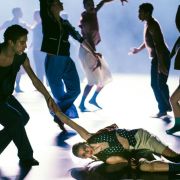
NDT2’s latest programme entitled I dreamt, it was presented two works that complemented each other in dynamic ways.

The first piece, Kill Your Darlings, was choreographed by Imre van Opstal and Marne van Opstal, two former dancers of NDT. Since their departure, the sibling team have continued to develop artistically, creating works for other contemporary companies and major ballet institutions such as the Paris Opera Ballet.
Kill Your Darlings is an original work created for NDT2 which premiered in March of this year. The work reflects on society’s frenetic pace and addiction to quick hits of dopamine. Ironically, Kill Your Darlings does the opposite of its namesake, overloading the audience with a barrage of disjointed scenes that purposely overwhelm to induce a kind of ‘dance scrolling’.
The ensemble enters the stage, walking in silhouette in a robotic fashion – dancers as data waiting to download and for the algo-rhythm to commence. The theatrical use of lighting by Tom Visser simulate electronic currents that periodically break and glitch, while the dancers work through various scenarios in rapid succession that mirror our current addiction to overstimulation.

The choreographed episodes seemed to force the dancers into manic moments of movement which was unnerving to watch as there was barely a moment to hold on to or process. And yet, isn’t that the whole point of the piece?
Interestingly, Imre and Marne van Opstal added a heavy dose of Dutch national identity, using Herman van Veen’s song Opzij as a didactic moment and a flash of hakken to some hard techno by AZYR.
On the whole, Kill Your Darlings felt at times reductive but in the best possible sense in that it certainly put the young company through its paces, showcasing their raw talent. The eclectic costuming of trendy outerwear which paralleled the dizzying array of dance ideas made Darlings feel designed for a young ‘Vinted’ crowd who may be new to the contemporary dance landscape, and the added touch of Dutch-ness ensured its success as it tours within the Netherlands.

Originally created for the Gothenburg Opera Dance Company, Sharon Eyal and Gai Behar’s SAABA is one of their best works. Since its world premiere in 2021, SAABA has been danced with other European dance companies. Eyal’s personal modifications to the work made especially for NDT2, particularly in the costuming, is exemplar of the strong ties between Eyal and the dance artists.
For those familiar with Eyal, SAABA captures the mesmeric and hypnotic sensuality of her dance language. The repetitive movement – often performed on demi-pointe, a signature of her work – is both meditative and trance-like, underscored by pulsating music that weaves seamlessly through world beats and techno infused rhythms. The shifts in movement, sometimes subtle or sharp, are punctuated in the musical composition by Ori Lichtik. The ensemble moves together with a kind of hive-mind like a strange amoeba, detaching and reattaching.
The subversion of balletic notions make SAABA emote with a kind of queer yearning. There are nods to Swan Lake, except the swans here are featherless, their wings exposed bare as they bourrée repetitively through various murmurs and clusters.

The pairing of Kill Your Darlings and SAABA was ingeniously devised, allowing both choreographic works to not only complement each other but give the young dancers the opportunity to display their artistic range. The costumes and didactic approach of Darlings showcased a youthful exuberance in NDT2 which, at times, bordered on adolescent in its approach. SAABA allowed the dancers to luxuriate in a kind of dance pilgrimage through stages of exquisite tribulations derived from repetitious somatic movement.
Perhaps Kill Your Darlings will grow on me over time but I’m more curious to see how Imre and Marne van Opstal develop in collaboration with the premium dance talent at NDT. As former dancers themselves they have a unique perspective on what to contribute to their alma mater. SAABA feels like a piece that will continue to ripen and blossom in years to come.
At the performance I saw, César Sautés-Vescovali had a strong showing in both pieces. His solo in Darlings was impressionable. Sophia Frilot really captured the essence of SAABA, becoming the focal point at the end of the piece and commanding both the strength and vulnerability the work demanded.